Delta Ratio Formula Explained
The delta ratio formula ΔAG / ΔHCO₃⁻ = (AG − 12) / (24 − HCO₃⁻) resolves whether a high anion gap metabolic acidosis is pure or mixed with a second disorder. Here is the derivation, the four interpretation bands, and a worked example for each.
The delta ratio equation
The delta ratio compares two "deltas" — the change in the anion gap and the change in serum bicarbonate — to determine whether a single acid–base process explains both, or whether a second disorder is hiding alongside it. The premise is physiological: in an uncomplicated high-anion-gap metabolic acidosis (HAGMA), every organic anion that accumulates (lactate, ketoacid, sulfate) consumes one bicarbonate molecule as it is buffered. The rise in the anion gap should therefore approximately equal the fall in bicarbonate, giving a ratio near 1. Deviations from 1 signal a second, simultaneous process.
Writing the two deltas explicitly, using the conventional normals of AG 12 and HCO₃⁻ 24 mEq/L, gives the formula:
The numerator (ΔAG) is how far the anion gap has climbed above its normal value of 12; the denominator (ΔHCO₃⁻) is how far bicarbonate has fallen below its normal value of 24. Dividing the two yields a dimensionless ratio that classifies the acid–base picture into one of four bands. This is the conceptual sibling of the delta gap formula, which expresses the same comparison as a difference rather than a ratio.
The four interpretation bands
| Delta ratio | Interpretation | What is happening |
|---|---|---|
| < 0.4 | Pure NAGMA | Bicarbonate falls with little or no rise in the AG — a hyperchloremic (normal-anion-gap) metabolic acidosis such as diarrhea or renal tubular acidosis. |
| 0.4 – 0.8 | Mixed HAGMA + NAGMA | AG rises but bicarbonate falls disproportionately — a combined high-anion-gap and normal-anion-gap metabolic acidosis. |
| 1 – 2 | Pure HAGMA | AG rise matches bicarbonate fall — an uncomplicated high-anion-gap metabolic acidosis (lactic acidosis, DKA, renal failure). |
| > 2 | HAGMA + metabolic alkalosis | AG rises more than bicarbonate falls — a pre-existing or concurrent metabolic alkalosis (vomiting, diuretics) is masking the full bicarbonate drop. |
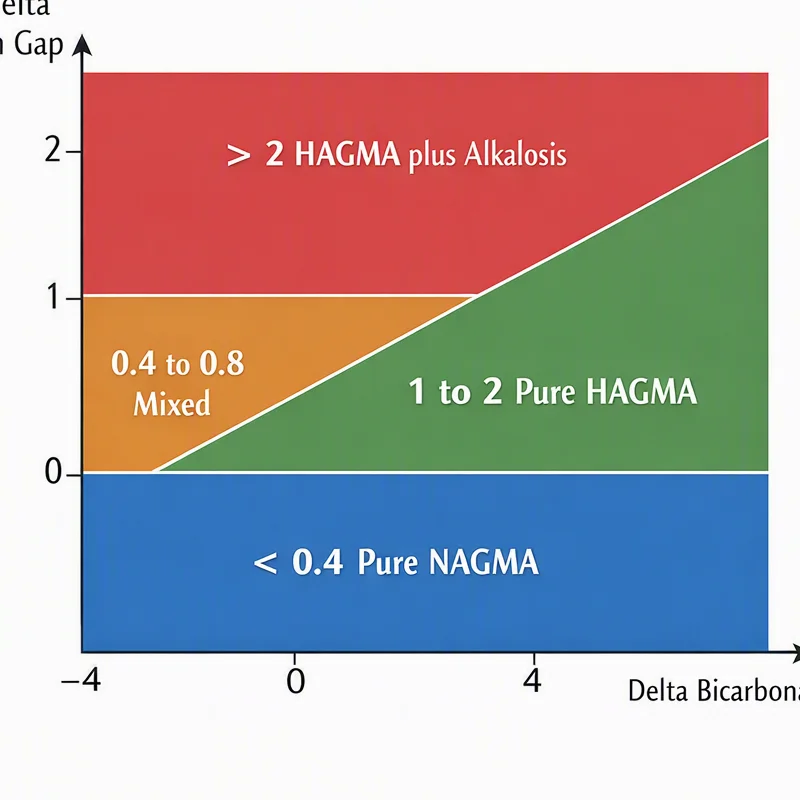
Worked examples for each band
Band 1 — pure HAGMA (ratio ≈ 1). A patient in septic shock has Na⁺ 138, Cl⁻ 101, HCO₃⁻ 14. The anion gap is 138 − (101 + 14) = 23, so ΔAG = 23 − 12 = 11, and ΔHCO₃⁻ = 24 − 14 = 10. Ratio = 11 / 10 = 1.1 — squarely in the 1–2 band, consistent with uncomplicated lactic acidosis. Confirm the arithmetic in the delta ratio calculator.
Band 2 — mixed HAGMA + NAGMA (ratio 0.4–0.8). A patient with profuse diarrhea and developing sepsis has Na⁺ 136, Cl⁻ 110, HCO₃⁻ 16. AG = 136 − (110 + 16) = 10, so ΔAG = 10 − 12 = −2, and ΔHCO₃⁻ = 24 − 16 = 8. Ratio = −2 / 8 = −0.25 (treated as < 0.4), flagging a dominant hyperchloremic component. A more typical mixed case: AG 18, HCO₃⁻ 14 gives ΔAG 6 and ΔHCO₃⁻ 10, ratio 0.6 — a combined high-AG and normal-AG metabolic acidosis. These mixed pictures are dissected further on the mixed disorders page.
Band 3 — HAGMA + metabolic alkalosis (ratio > 2). A patient with DKA who has also been vomiting has Na⁺ 140, Cl⁻ 95, HCO₃⁻ 18. AG = 140 − (95 + 18) = 27, so ΔAG = 27 − 12 = 15, and ΔHCO₃⁻ = 24 − 18 = 6. Ratio = 15 / 6 = 2.5 — the ketoacidosis is raising the gap, but the vomiting-driven metabolic alkalosis is propping bicarbonate up, shrinking ΔHCO₃⁻ and inflating the ratio.
Buffering is imperfect and organic anions also redistribute into the extracellular fluid with a slightly different stoichiometry than 1:1, so a pure HAGMA typically lands between 1.0 and 2.0 rather than exactly at 1. Ratios genuinely close to 1.0 are the cleanest single-process cases; values near 2.0 already hint at an emerging second process.
Two caveats deserve emphasis. First, the delta ratio is only meaningful when the anion gap is genuinely elevated and the bicarbonate is genuinely low — a normal bicarbonate makes the denominator zero and the ratio undefined. Second, hypoalbuminemia distorts the input AG itself, so always apply the albumin correction before computing the ratio in critically ill patients.