The Anion Gap Calculator
Calculate the anion gap from serum electrolytes in seconds — with albumin correction and instant clinical interpretation.
What is the anion gap?
The anion gap is the difference between the measured cations (positively charged ions, mainly sodium) and the measured anions (negatively charged ions, mainly chloride and bicarbonate) in the blood. It is calculated from the standard metabolic panel using the formula Na⁺ − (Cl⁻ + HCO₃⁻), and it is the single most useful laboratory screen for metabolic acidosis.
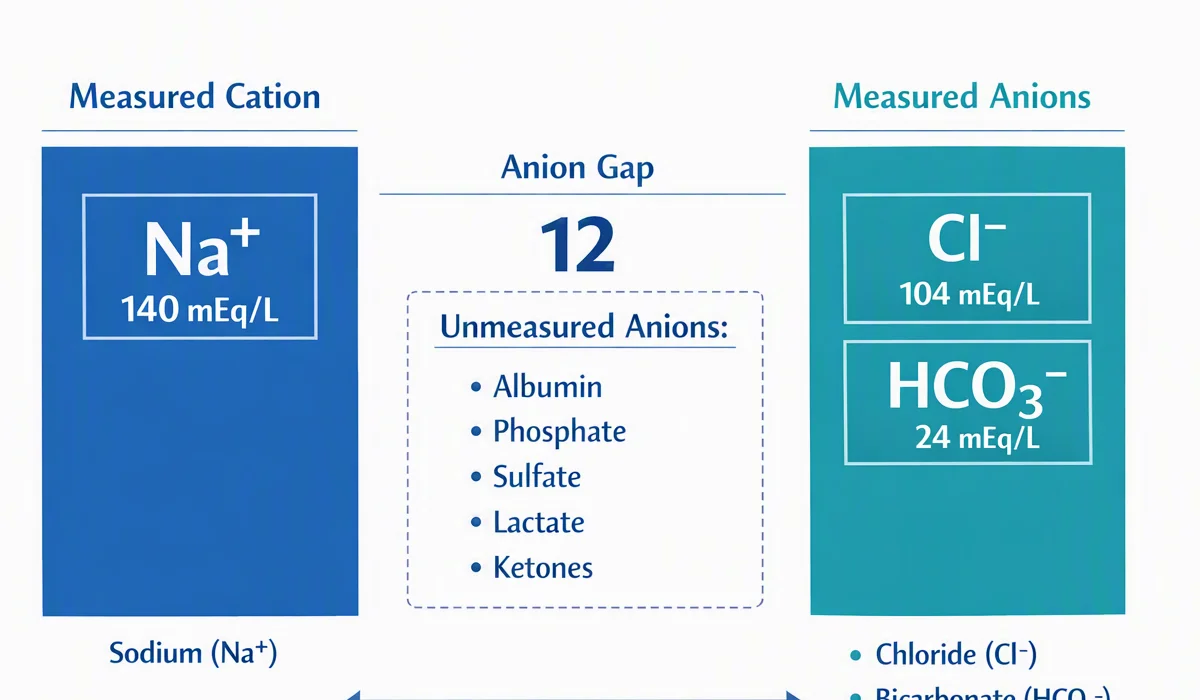
The gap exists because the body maintains electroneutrality — total positive charges must equal total negative charges. Sodium is balanced not only by chloride and bicarbonate but also by "unmeasured" anions such as albumin, phosphate, sulfate, and organic anions (lactate, ketones). When these unmeasured anions accumulate, the anion gap rises. A high anion gap therefore flags the presence of acids the routine panel does not directly measure.
What is a normal anion gap?
By the conventional formula, the reference range is 8–12 mEq/L. Modern autoanalyzers using ion-selective electrodes often report a tighter range of 3–11 mEq/L because of higher measured chloride values. Each laboratory prints its own reference interval — always interpret against the local range, and correct for albumin before deciding the gap is truly normal.
Quick reference table
| Anion gap | Interpretation | Typical causes |
|---|---|---|
| < 8 | Low | Hypoalbuminemia, paraproteinemia, lab error |
| 8–12 | Normal | — (or masked acidosis if albumin low) |
| 13–20 | Mildly elevated | Early HAGMA — lactate, ketoacidosis, renal |
| > 20 | Markedly elevated | Overt HAGMA — toxins, DKA, lactic acidosis |
How to interpret your result
A high anion gap points to a high-anion-gap metabolic acidosis (HAGMA). The classic mnemonic is MUDPILES (Methanol, Uremia, DKA, Propylene glycol, Iron/INH, Lactic acidosis, Ethylene glycol, Salicylates), increasingly updated to GOLD MARK to include modern culprits. A normal anion gap during acidosis suggests a hyperchloremic (normal-anion-gap) metabolic acidosis (NAGMA) — think diarrhea, renal tubular acidosis, or saline dilution.
When the gap is elevated and the bicarbonate is low, the delta-delta ratio (ΔAG / ΔHCO₃⁻) helps separate a pure HAGMA from a mixed disorder. A ratio near 1 is pure HAGMA; below 0.8 suggests a concurrent NAGMA; above 2 suggests a concurrent metabolic alkalosis.
In critically ill or hypoalbuminemic patients, always compute the albumin-corrected anion gap, because a low albumin can make a true HAGMA look falsely normal — see why albumin matters in anion gap interpretation.
Start here — the essentials
The most-used calculators and interpretation guides on the site.
Explore every anion gap tool & resource
A complete topical hub — calculators, formulas, interpretation, disorders, causes, and clinical depth, all linked from this central page.
Calculate. Interpret. Decide.
Every anion gap variant, formula, and clinical guide — in one fast, free hub.
Open the calculator