High Anion Gap — Causes & Workup
A high anion gap means unmeasured anions are accumulating in the blood. It is the cardinal laboratory clue to high anion gap metabolic acidosis (HAGMA) and triggers a focused search for lactate, ketones, renal failure, and toxins.
What is a high anion gap?
A high anion gap is a serum anion gap above the laboratory's reference interval — conventionally AG > 12 mEq/L by the formula Na⁺ − (Cl⁻ + HCO₃⁻). You can confirm your own value in seconds with our anion gap calculator. Physiologically, the gap exists because the body preserves electroneutrality: sodium is balanced not only by chloride and bicarbonate but also by "unmeasured" anions — albumin, phosphate, sulfate, lactate, and ketones. When these accumulate faster than bicarbonate can buffer them, the measured gap widens.
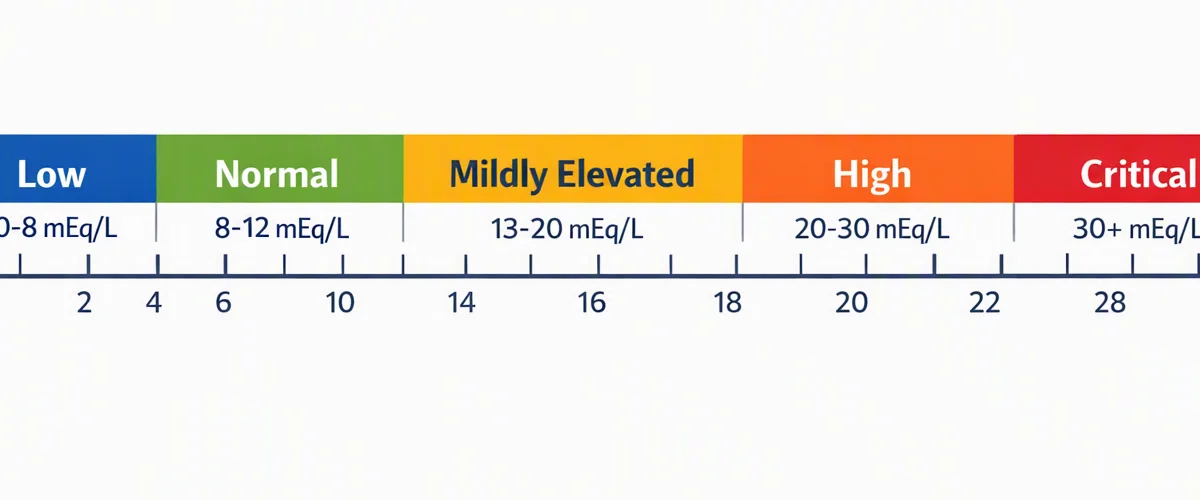
What does a high anion gap mean? It signals that an acid the routine electrolyte panel does not directly measure is being added to the blood — the hallmark of high anion gap metabolic acidosis (HAGMA). A mildly elevated gap (13–20 mEq/L) may reflect early lactic acidosis, ketoacidosis, or uremia, while a markedly elevated gap (>20 mEq/L) is rarely anything other than overt HAGMA and demands urgent evaluation.
A high anion gap (>12 mEq/L) indicates that unmeasured anions — lactate, ketones, sulfates, or toxin metabolites — have accumulated in the blood faster than bicarbonate can buffer them. It is the laboratory signature of high anion gap metabolic acidosis (HAGMA) and prompts a focused workup to identify the cause. Always correct for albumin first, since hypoalbuminemia can mask a true elevation.
Causes of a high anion gap
The classic differential is taught with the MUDPILES mnemonic, increasingly updated to GOLD MARK to reflect modern ICU culprits. Both lists cover the same physiological territory: endogenous organic acids (lactate, ketones), inorganic acid retention (uremia), and exogenous toxins.
The newer GOLD MARK mnemonic (Glycols, 5-oxoproline, L-lactate, D-lactate, Methanol, Aspirin, Renal failure, Ketoacidosis) is preferred in many critical-care settings because it foregrounds the toxic alcohols and D-lactate, which MUDPILES buries or omits (Kraut & Madias, StatPearls 'Serum Anion Gap'; LITFL Acid-Base). For the full expanded list with clinical pearls, see our dedicated GOLD MARK mnemonic reference.
Quick reference: anion gap ranges
| Anion gap (mEq/L) | Interpretation | Typical pattern |
|---|---|---|
| 8–12 | Normal | — (or masked acidosis if albumin low) |
| 13–20 | Mildly elevated | Early HAGMA — lactate, ketones, renal |
| > 20 | Markedly elevated | Overt HAGMA — toxins, DKA, severe lactic acidosis |
| > 30 | Markedly elevated | Strongly suggests toxic alcohol ingestion |
How to work up a high anion gap
Once an elevated anion gap is identified, work in parallel — the history (toxin exposure, diabetes, sepsis), the exam, and a focused laboratory panel all run together. A practical sequence:
- Confirm with a repeat panel. Re-draw the basic metabolic panel to rule out sampling error and trend the gap. Recalculate with the anion gap formula and re-check the bicarbonate trend.
- Check the albumin and correct. Hypoalbuminemia lowers the expected "normal" gap by ~2.5 mEq/L per 1 g/dL drop — a critically ill patient with albumin 2.0 g/dL has a baseline gap near 4, not 12 (Figge et al., Critical Care Medicine). Use the albumin-corrected anion gap before declaring the elevation real.
- Measure serum lactate. Lactic acidosis is the single most common cause of HAGMA in hospitalized patients. A lactate > 2 mmol/L with an elevated gap confirms it; a lactate > 5 mmol/L is associated with sharply rising mortality and is considered ominous (Surviving Sepsis Campaign; Kraut & Madias, CJASN). Investigate Type A (hypoperfusion, sepsis, shock) versus Type B (metformin, malignancy, mitochondrial toxins).
- Test for ketones. In the diabetic or pregnant patient, check serum β-hydroxybutyrate (more sensitive than urine ketones) for diabetic, alcoholic, or starvation ketoacidosis.
- Assess renal function. Elevated BUN and creatinine with a high gap point to uremic acid retention from acute kidney injury or advanced CKD.
- Calculate the osmolar gap. A simultaneously elevated anion gap and osmolar gap is the classic signature of toxic alcohol ingestion (methanol, ethylene glycol). Compute it with the osmolar gap calculator and send toxic alcohol levels if > 20 mOsm/kg.
- Check toxin levels when indicated. Salicylate level (mixed respiratory alkalosis + HAGMA), methanol/ethylene glycol assays, and a metformin level in the right context close the loop on exogenous causes.
In hypoalbuminemic, cirrhotic, or nephrotic patients, an uncorrected anion gap can look deceptively normal — hiding a true HAGMA. Always compute the albumin-corrected anion gap (AG + 2.5 × (4.0 − albumin)) before concluding the gap is normal. See our full guide to why albumin correction changes interpretation.
Throughout the workup, track the delta ratio (ΔAG / ΔHCO₃⁻): a ratio near 1 confirms a pure HAGMA, below 0.8 points to a concurrent normal-anion-gap metabolic acidosis, and above 2 suggests a coexisting metabolic alkalosis — a mixed disorder that changes management.
Treatment by cause
Management is cause-specific rather than directed at the gap itself — the anion gap is a sign, not a disease. The bicarbonate falls as it buffers the offending acid, so once the underlying process is halted (insulin for DKA, source control for sepsis, fomepizole for toxic alcohols), the gap corrects as the kidneys excrete the unmeasured anion. Supportive care — intravenous fluids, electrolyte correction, and ventilatory support — bridges the interval while the definitive therapy takes hold (Kitabchi et al., ADA Consensus; Surviving Sepsis Campaign).
| Cause | Treatment |
|---|---|
| DKA | Insulin, IV fluids, potassium replacement |
| Lactic acidosis (sepsis) | Source control, antibiotics, perfusion |
| Toxic alcohols | Fomepizole, hemodialysis |
| Renal failure | Dialysis |
Key takeaways
- A high anion gap (>12 mEq/L) means unmeasured anions are accumulating — the signature of high anion gap metabolic acidosis (HAGMA).
- The differential is captured by MUDPILES / GOLD MARK: lactate, ketones, uremia, and toxins.
- Always correct for albumin first; hypoalbuminemia is the most common reason a true HAGMA is missed.
- A high AG with a high osmolar gap strongly suggests a toxic alcohol — a time-critical diagnosis.
When to worry about a high anion gap
The urgency of a high anion gap tracks its magnitude. A gap of 12–16 mEq/L is mild and usually non-urgent — repeat the panel, correct for albumin, and work up the cause in parallel. A gap of 16–20 mEq/L is moderate and warrants a structured workup (lactate, ketones, renal function, osmolar gap) within hours. A gap above 20 mEq/L is significant and demands urgent evaluation — at this level HAGMA is essentially certain and the question is which acid. A gap above 30 mEq/L is critical and strongly suggests toxic alcohol ingestion (methanol, ethylene glycol), severe DKA, or fulminant lactic acidosis — each of which can be fatal within hours without targeted therapy (Kraut & Madias, StatPearls 'Serum Anion Gap'). For a value-by-value breakdown, see our guide to what specific anion gap values mean.
These signs suggest the acid load is overwhelming compensatory mechanisms and may indicate shock, severe DKA, or a toxic ingestion. Do not wait for repeat labs — go to the nearest emergency department.
Symptoms of a high anion gap
A high anion gap produces no symptoms on its own — what the patient feels are the effects of the underlying acidosis. As the blood acidifies, the body compensates with Kussmaul breathing: deep, rapid respirations driven by the medulla to blow off CO₂ and buffer the acid load. Patients commonly describe fatigue, confusion or decreased alertness, nausea and vomiting, and abdominal pain. In severe acidosis, hypotension and shock follow. Because these symptoms overlap with dozens of conditions, the anion gap is usually discovered on a chemistry panel rather than suspected from the history. A fuller discussion is on our anion gap symptoms page.
Confirm the gap. Find the cause.
Calculate the anion gap, correct for albumin, and check the delta ratio — all in one free, fast hub.
Open the anion gap calculator