Anion Gap Calculator
Calculate the anion gap from serum sodium, chloride, and bicarbonate. Instant clinical interpretation against the 8–12 mEq/L reference range, with an optional albumin-corrected result for hypoalbuminemic patients.
How to calculate the anion gap
The anion gap is the difference between the serum's measured cations (positive ions) and its measured anions (negative ions). To calculate the anion gap, take the sodium concentration and subtract the sum of chloride and bicarbonate: AG = Na⁺ − (Cl⁻ + HCO₃⁻)1. The result, expressed in mEq/L, is the gap left over — a window onto the "unmeasured" anions (albumin, phosphate, lactate, ketones) that the routine panel does not directly quantify2. This relationship comes straight from the anion gap formula derived from the principle of electroneutrality, which requires total positive charges to equal total negative charges.
Worked example
Consider a patient with sodium 140, chloride 104, and bicarbonate 24 mEq/L. Apply the anion gap equation: 140 − (104 + 24) = 140 − 128 = 12 mEq/L. That sits at the top of the conventional 8–12 reference interval, so the result reads as normal. Contrast that with a septic patient whose panel shows sodium 138, chloride 101, and bicarbonate 18: 138 − (101 + 18) = 138 − 119 = 19 mEq/L, a mildly elevated gap pointing toward lactic acidosis and a high anion gap metabolic acidosis.
What the result means
The conventional reference interval for the anion gap is 8–12 mEq/L2, though modern ion-selective autoanalyzers often tighten this to 3–11 mEq/L because they report higher chloride values1. Always compare your result to the reference range printed by the laboratory that ran the panel. The table below summarizes how the calculator classifies each band.
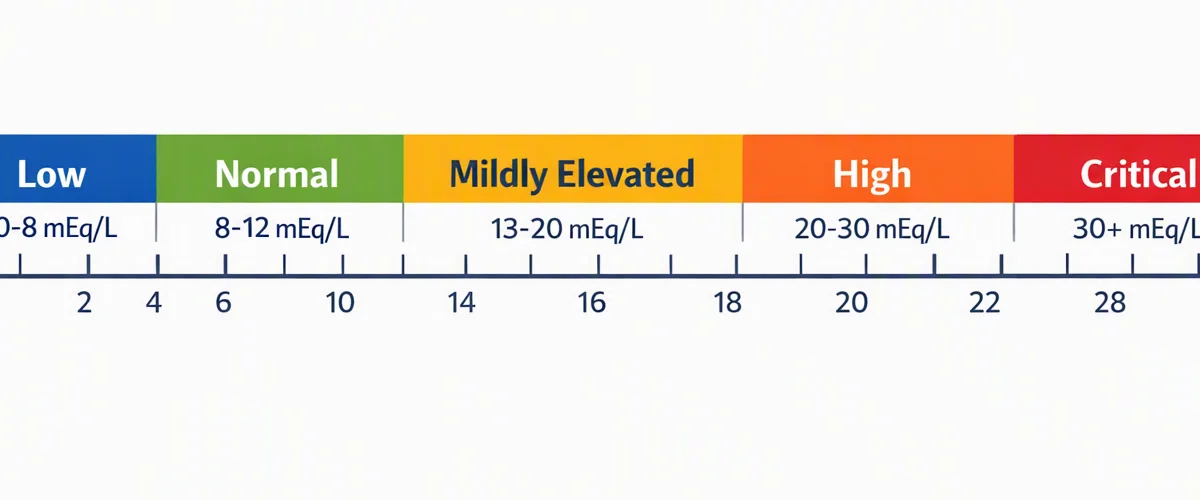
| Anion gap (mEq/L) | Interpretation | Clinical direction |
|---|---|---|
| < 8 | Low | Hypoalbuminemia, paraproteinemia (myeloma), lithium, or lab error. |
| 8–12 | Normal | Normal, or a masked high-AG acidosis if albumin is low (see below). |
| 13–20 | Mildly elevated | Early high-anion-gap metabolic acidosis — lactate, ketoacidosis, renal failure. |
| > 20 | Markedly elevated | Overt HAGMA — pursue toxins, DKA, severe lactic acidosis urgently. |
A result in the 8–12 band does not, on its own, exclude acidosis. In a critically ill or hypoalbuminemic patient the "unmeasured" anion pool shrinks because albumin — the dominant unmeasured anion — falls, dragging the apparent gap down with it. That is why an isolated normal value should be interpreted in context, and why the albumin correction exists.
When to use the albumin-corrected anion gap
Every 1 g/dL fall in serum albumin lowers the expected "normal" anion gap by roughly 2.5 mEq/L3. Toggle Albumin correction in the calculator above to apply the Figge equation: corrected AG = observed AG + 2.5 × (4.0 − albumin g/dL)3. Returning to the septic example above (observed AG 19, albumin 2.5 g/dL): the corrected gap is 19 + 2.5 × (4.0 − 2.5) = 19 + 3.75 = 22.75 mEq/L — markedly elevated, confirming an acidosis that the raw number alone understated.
This calculator runs entirely in your browser — no values are transmitted or stored. Reference values and interpretation logic are reviewed against StatPearls and the Life in the Fast Lane (LITFL) acid–base resources. Results are informational only and should always be interpreted in full clinical context by a qualified clinician.
References
- Pandey DG, Sharif A. "Biochemistry, Anion Gap." StatPearls [Internet]. Treasureville (FL): StatPearls Publishing; 2023. NCBI Bookshelf ↗
- Kraut JA, Madias NE. "Serum Anion Gap: Its Uses and Limitations in Clinical Medicine." Clin J Am Soc Nephrol. 2007;2(1):162–174. PubMed ↗
- Figge J, Jabor A, Kazda A, Fencl V. "Anion gap and hypoalbuminemia." Crit Care Med. 1998;26(11):1807–1810. PubMed ↗
- Life in the Fast Lane (LITFL). "Anion Gap." litfl.com/anion-gap ↗