High Anion Gap Metabolic Acidosis (HAGMA)
A metabolic acidosis driven by the accumulation of unmeasured anions — lactate, ketones, uremic acids, and toxins — that widen the anion gap above 12 mEq/L. Here is how to recognize, work up, and treat HAGMA.
What is HAGMA?
High anion gap metabolic acidosis (HAGMA) is the form of metabolic acidosis in which the serum anion gap is elevated — conventionally above 12 mEq/L, or above the upper limit of your laboratory's reference range. It arises when endogenous or exogenous unmeasured anions accumulate in the blood faster than the kidneys and lungs can compensate.
The routine metabolic panel measures sodium (Na⁺), chloride (Cl⁻), and bicarbonate (HCO₃⁻) but does not directly measure lactate, β-hydroxybutyrate, sulfate, phosphate, or organic acid anions. When these "hidden" anions accumulate, electroneutrality forces bicarbonate down, and the calculated anion gap calculator result climbs. A high anion gap therefore signals the presence of acids the standard panel cannot see directly.
The condition is always pathological and frequently reflects a medical emergency — septic shock with lactic acidosis, diabetic ketoacidosis, uremia, or toxic alcohol poisoning among them. The priority is to identify the offending acid rapidly, because the treatment of HAGMA is the treatment of its cause.
Causes — the MUDPILES / GOLD MARK framework
The classic teaching mnemonic for HAGMA causes is MUDPILES, increasingly supplanted by the more contemporary GOLD MARK framework, which incorporates modern culprits (metformin, propylene glycol) and demotes rarer entries. Both encode the same insight: every cause produces a specific unmeasured anion.
In practice the causes cluster into a handful of categories: lactic acidosis (sepsis, shock, medications), ketoacidosis (diabetic, alcoholic, starvation), renal failure (retained sulfate, phosphate, and organic anions in advanced CKD/AKI), and toxins (methanol, ethylene glycol, salicylates, metformin). Each generates a characteristic unmeasured anion that widens the gap. See the full MUDPILES mnemonic breakdown with each letter explained.
GOLD MARK (Glycols, Oxoproline, L-lactate, D-lactate, Methanol, Aspirin, Renal failure, Ketoacidosis) is preferred in modern practice because it explicitly lists the toxic alcohols, recognizes 5-oxoproline from chronic paracetamol/glutathione depletion, and acknowledges D-lactate from bacterial overgrowth (Kraut & Madias, CJASN). The full expanded differential, with mechanism and clues for each, is in the dedicated MUDPILES mnemonic reference.
Pathophysiology
To understand why the anion gap rises, return to the principle of electroneutrality: total positive charges must equal total negative charges. Sodium, the dominant measured cation, is balanced by chloride and bicarbonate on the anion side, plus a small pool of "unmeasured" anions — chiefly albumin and phosphate — that constitute the normal gap. For a deeper treatment, see unmeasured anions and cations.
In this disorder, a new acid (HA) enters the extracellular fluid and dissociates into H⁺ and A⁻. The hydrogen ion is buffered by bicarbonate: H⁺ + HCO₃⁻ → H₂O + CO₂. For every mole of acid neutralized this way, one mole of bicarbonate is consumed, and one mole of the new anion A⁻ is left behind. Because the formula Na⁺ − (Cl⁻ + HCO₃⁻) does not count A⁻, the gap widens by exactly the amount bicarbonate fell — provided no other disorder is present.
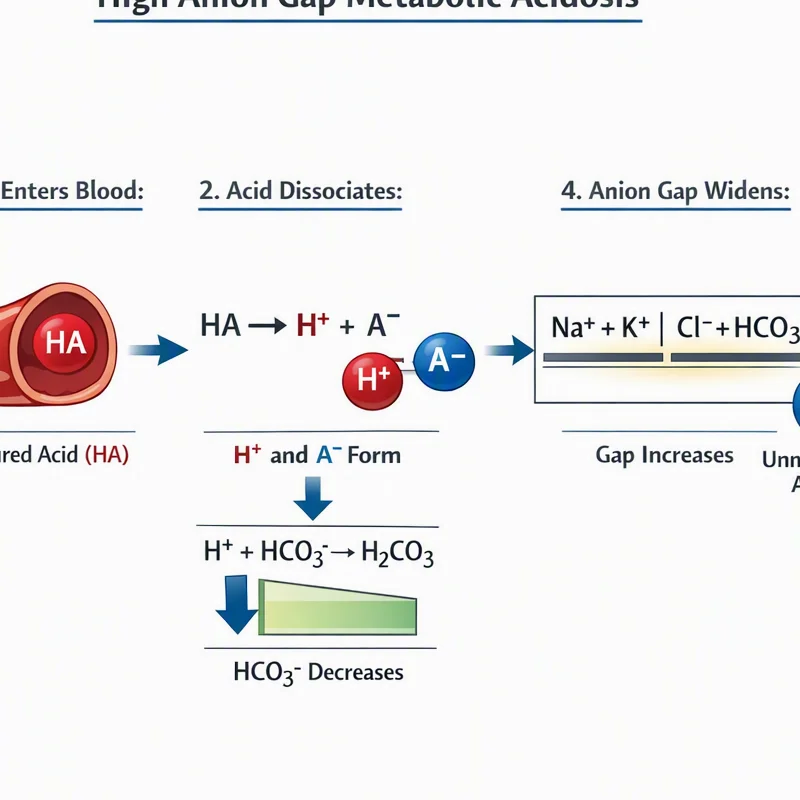
This one-for-one relationship is the basis of the delta ratio. If the rise in the gap precisely matches the fall in bicarbonate, the disorder is a pure HAGMA. If the gap rises less than expected, a concurrent hyperchloremic (normal anion gap) acidosis is also present; if bicarbonate falls less than expected, a metabolic alkalosis is hidden alongside the condition.
Diagnosis and workup
The HAGMA workup is a stepwise narrowing of the differential. Each step either confirms the gap is real or points to a specific offending acid, and the steps follow the pathophysiology outlined above.
- Confirm the anion gap is elevated. Calculate
Na⁺ − (Cl⁻ + HCO₃⁻)and compare against your lab's reference interval. A gap above 12 mEq/L is the conventional threshold; above 20 mEq/L is almost always clinically significant HAGMA. - Albumin-correct the gap. Hypoalbuminemia lowers the expected "normal" gap by approximately 2.5 mEq/L per 1 g/dL of albumin below 4.0. Use the albumin-corrected anion gap so a low albumin does not falsely mask HAGMA in critically ill patients.
- Calculate the delta ratio. The delta ratio (ΔAG / ΔHCO₃⁻) tells you whether the HAGMA is isolated or part of a mixed acid-base disorder. A ratio near 1 supports pure HAGMA; below 0.8 suggests concurrent NAGMA; above 2 suggests concurrent metabolic alkalosis.
- Hunt for the offending acid. Check serum lactate, ketones (β-hydroxybutyrate), renal function (BUN/creatinine), a toxic alcohol history, and salicylate level. When toxic alcohol ingestion is suspected, measure the osmolar gap — a concurrent osmolar gap plus HAGMA is virtually diagnostic of methanol or ethylene glycol poisoning until proven otherwise.
- Assess compensation. Use Winter's formula
1.5 × HCO₃⁻ + 8 ± 2to verify appropriate respiratory compensation. An actual PaCO₂ higher than predicted indicates a concurrent respiratory acidosis; lower than predicted indicates respiratory alkalosis (a common finding in salicylate toxicity and sepsis).
Treatment principles
The central rule in HAGMA management is straightforward: treat the cause, not the number. The gap is a sign; the disease is the offending acid. Insulin and fluids resolve DKA; antibiotics, source control, and perfusion reverse septic lactic acidosis; dialysis clears methanol, ethylene glycol, and salicylates; fomepizole blocks alcohol dehydrogenase in toxic alcohol ingestion. As the underlying process resolves, the gap closes on its own — typically over hours to days.
Exogenous bicarbonate is not routine in HAGMA. Most guidelines reserve it for severe acidaemia (arterial pH < 7.1, or bicarbonate < 6 mEq/L in DKA) where the haemodynamic instability of profound acidosis outweighs the downsides — volume overload, hypokalaemia, hypocalcaemia, hypernatraemia, and paradoxical CSF acidosis (Kitabchi et al., ADA Consensus; Surviving Sepsis Campaign). Even then, the goal is partial pH correction toward 7.15–7.20, not normalization. In lactic acidosis specifically, bicarbonate has shown no mortality benefit.
Serial anion gap measurements are the most useful tracking tool. A falling value indicates the cause is being addressed; a gap that plateaus or rises warrants re-evaluation for ongoing acid production (continued seizure, unresolved shock, unresected ischemic bowel) or an alternative diagnosis.
HAGMA vs NAGMA
Metabolic acidosis bifurcates into HAGMA (gap widened by unmeasured anions) and normal anion gap metabolic acidosis (NAGMA) (gap unchanged because bicarbonate is lost directly or replaced by chloride — hence the synonym hyperchloremic metabolic acidosis). The distinction is purely the value, but it completely redirects the differential: this disorder demands a search for hidden acids, while NAGMA points to the gut, kidney tubules, or saline dilution.
| Feature | HAGMA | NAGMA |
|---|---|---|
| Anion gap | Elevated (> 12 mEq/L) | Normal (8–12 mEq/L) |
| Primary defect | Gain of unmeasured acid | Net loss of HCO₃⁻ or gain of Cl⁻ |
| Chloride | Variable | Proportionally high (hyperchloremic) |
| Representative causes | Lactate, ketones, uremia, toxins | Diarrhea, renal tubular acidosis, saline |
| Delta ratio | ≈ 1 (pure) | ≈ 0 (hyperchloremic component) |
Both disorders can coexist. The classic example is a septic patient resuscitated with large volumes of normal saline who develops lactic acidosis (HAGMA) and simultaneous hyperchloremic acidosis (NAGMA) — detected only by a delta ratio in the intermediate 0.4–0.8 band.