Normal Anion Gap Metabolic Acidosis (NAGMA)
A metabolic acidosis in which the anion gap stays in the normal 8–12 mEq/L range because bicarbonate is lost directly or replaced by chloride — the "hyperchloremic metabolic acidosis." Here is how to distinguish GI loss from renal tubular acidosis and treat each correctly.
What is NAGMA?
Normal anion gap metabolic acidosis (NAGMA) is the form of metabolic acidosis in which the serum anion gap remains within the reference range of 8–12 mEq/L. The acidosis instead comes from a net loss of bicarbonate (HCO₃⁻) or a gain of chloride (Cl⁻) — which is why NAGMA is also called hyperchloremic metabolic acidosis.
The mechanism is the mirror image of HAGMA. When bicarbonate is lost through the gut or kidney, or diluted by chloride-rich fluids, electroneutrality is preserved by a matching rise in chloride. Because both bicarbonate and chloride are measured ions, they drop out of the gap equation together — Na⁺ − (Cl⁻ + HCO₃⁻) stays unchanged. The patient is acidotic, but the gap looks normal.
The diagnostic question in any normal anion gap metabolic acidosis is therefore not "what hidden acid is present?" but "where is the bicarbonate going?" The answer is almost always the gastrointestinal tract, the renal tubules, or the IV fluid bag.
Causes
NAGMA causes group cleanly into three buckets: GI bicarbonate loss, renal acid excretion failure (renal tubular acidosis), and iatrogenic chloride gain. The full expanded list lives in the causes of normal anion gap acidosis reference.
| Category | Examples | Mechanism |
|---|---|---|
| GI bicarbonate loss | Diarrhea, pancreatic or biliary fistula, villous adenoma, ileostomy (high output), ureterosigmoidostomy | Alkaline pancreatic/biliary secretions and colonic bicarbonate-rich stool are lost faster than the kidney can reabsorb HCO₃⁻. |
| Renal — RTA type I (distal) | Autoimmune disease, amphotericin B, lithium, genetic | Distal nephron cannot secrete H⁺, so NH₄⁺ excretion fails; urine pH stays > 5.5 despite systemic acidosis. |
| Renal — RTA type II (proximal) | Fanconi syndrome, myeloma, ifosfamide, carbonic anhydrase inhibitors | Proximal tubule reabsorbs bicarbonate poorly above a lowered threshold (often ~14–18 mEq/L); HCO₃⁻ spills into urine. |
| Renal — RTA type IV | Hypoaldosteronism (diabetic nephropathy, Addison's, ACE inhibitors, K-sparing diuretics) | Low aldosterone blunts distal H⁺ and NH₃ secretion; ammonia generation falls. Hyperkalemia is the hallmark. |
| Iatrogenic | Excessive 0.9% saline, acetazolamide, cholestyramine, CaCl₂ / MgSO₄ infusions, TPN with arginine/lysine | Rapid Cl⁻ loading overwhelms bicarbonate, or a drug directly blocks HCO₃⁻ reabsorption (acetazolamide) or binds bile salts (cholestyramine). |
Diarrhea is the single most common NAGMA cause encountered in practice — the stool bicarbonate and organic-anion loss exceeds renal compensation. Volume-contracted patients additionally stimulate aldosterone, which worsens hypokalemia. Ureterosigmoidostomy is a classic exam cause: the colon reabsorbs urinary Cl⁻ in exchange for secreted HCO₃⁻, generating both NAGMA and hyperchloremia.
Using the urine anion gap to distinguish GI vs renal
Once NAGMA is confirmed, the next question is whether the kidney is appropriately excreting acid (GI cause) or failing to (renal cause). The urine anion gap calculator answers this by estimating urinary ammonium (NH₄⁺) excretion — a function no routine lab measures directly.
The urine anion gap formula is UAG = urine (Na⁺ + K⁺) − Cl⁻. Because NH₄⁺ is excreted mostly with chloride, a high urine Cl⁻ relative to Na⁺ + K⁺ implies ample NH₄⁺ excretion:
- UAG < 0 (typically −20 to −50): kidney is excreting large amounts of NH₄⁺ in response to the acid load → the cause is extra-renal (GI).
- UAG > 0 (typically +20 to +50): kidney is failing to excrete NH₄⁺ despite systemic acidosis → the cause is renal (RTA) or renal failure.
The urine anion gap is unreliable when urine sodium is very low (< 25 mEq/L, indicating volume depletion and low distal flow), or with ketoaciduria and toluene intoxication (unmeasured anions distort the calculation). In those settings, the urine osmolar gap is a more accurate NH₄⁺ surrogate.
Renal tubular acidosis — quick reference
The three RTA types are distinguished by their acidification defect, their serum potassium, and their urine pH. Type IV is by far the most common in adults and is nearly always associated with hyperkalemia — which immediately separates it from types I and II.
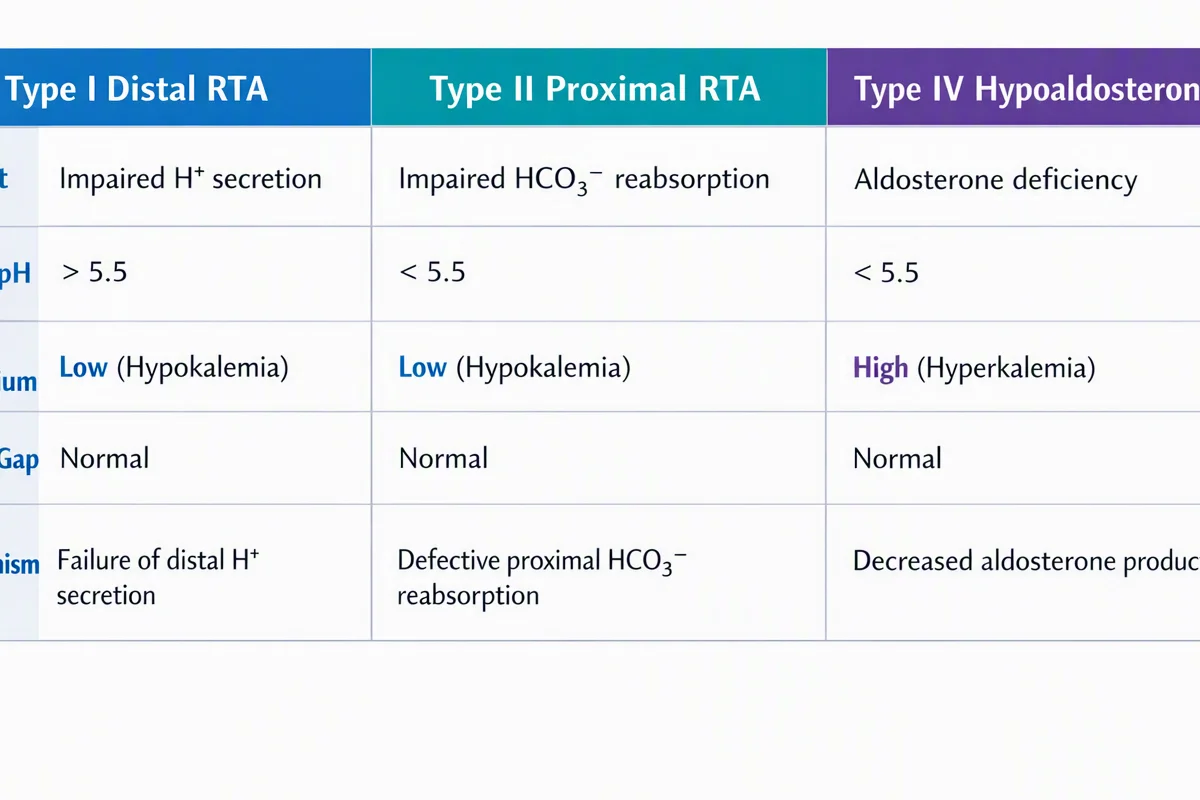
| RTA type | Defect | Urine anion gap | Serum K⁺ | Urine pH |
|---|---|---|---|---|
| Type I (distal) | Impaired distal H⁺ secretion | Positive (low NH₄⁺) | Low / normal (hypokalemia) | > 5.5 (inappropriately high) |
| Type II (proximal) | Lowered HCO₃⁻ reabsorption threshold | Positive once serum HCO₃⁻ is below threshold | Low (hypokalemia) | Variable; > 5.5 if serum HCO₃⁻ stable at new threshold |
| Type IV (hypoaldosteronism) | Reduced aldosterone effect → ↓ H⁺ and NH₃ secretion | Positive | High (hyperkalemia) | < 5.5 |
Type IV RTA is especially common in chronic kidney disease and diabetic nephropathy, where hyporeninemic hypoaldosteronism impairs distal acid and potassium handling. The hyperkalemia itself suppresses renal ammonia genesis, compounding the acidosis. Treating the hyperkalemia (kayexalate, diuretics, mineralocorticoid if deficient) often corrects the acidosis in parallel.
Treatment principles
As with HAGMA, treat the cause. Diarrhea-induced NAGMA resolves with volume repletion and control of the GI loss; iatrogenic saline NAGMA resolves when the fluid strategy is changed to a balanced crystalloid (lactated Ringer's, Plasma-Lyte). Drug-induced NAGMA (acetazolamide, topiramate) reverses when the offending agent is stopped.
In renal tubular acidosis the kidney cannot reclaim bicarbonate, so oral alkali replacement is the treatment. Type I and II RTA require 1–3 mEq/kg/day of sodium bicarbonate or citrate (citrate is preferred if the patient can tolerate it, as it generates bicarbonate in the liver). Type IV RTA is managed primarily by correcting hyperkalemia with fludrocortisone, loop diuretics, or potassium binders; alkali is added if acidosis persists. Treat to a target bicarbonate of 22–24 mEq/L, particularly in children, to protect growth and bone mineralization (Kraut & Madias, StatPearls 'Serum Anion Gap'; Kellum, Critical Care Medicine).
Always address potassium alongside bicarbonate. Type I and II RTA cause hypokalemia that worsens as alkali drives K⁺ into cells; potassium repletion must precede or accompany bicarbonate. Conversely, type IV RTA demands potassium lowering before aggressive alkali therapy. Mixed disorders — for example, a patient with CKD and diarrhea, or sepsis with concurrent saline loading — are common and are dissected with the delta ratio in the dedicated mixed acid-base disorders guide.