Osmolar Gap Calculator
The serum osmolar gap is used alongside the anion gap to screen for unmeasured osmoles such as methanol and ethylene glycol. It is the difference between measured and calculated osmolality, and includes the calculated osmolality formula with an optional ethanol term.
How the osmolar gap is calculated
The serum osmolar gap (sometimes called the osmolal gap) is the difference between the osmolality measured directly by the laboratory osmometer and the osmolality predicted from the serum chemistry panel. The standard calculated osmolality formula is 2 × Na⁺ + Glucose/18 + BUN/2.8, where glucose and BUN are entered in mg/dL (the divisors convert them to mmol/L)1. When the measured value exceeds the calculated value by more than the normal range allows, the implication is that unmeasured osmotically active particles are present in the blood. The osmolar gap is therefore measured − calculated, and the normal range is conventionally −10 to +10 mOsm/kg2.
An optional ethanol term (Ethanol / 4.6) can be added to the calculated osmolality when the patient is known to have consumed alcohol, so that the ethanol contribution does not itself inflate the gap. Toggle the switch above to expose the ethanol input.
Worked example
A patient with suspected toxic alcohol ingestion has a measured osmolality of 340 mOsm/kg, sodium 140, glucose 130, and BUN 14 mg/dL. The calculated osmolality is 2 × 140 + 130/18 + 14/2.8 = 280 + 7.2 + 5.0 = 292.2 mOsm/kg. The osmolar gap is 340 − 292.2 = 47.8 mOsm/kg — markedly elevated, signaling a large unmeasured osmole. Combined with the patient's anion gap result (say, AG 28), the pattern of a high anion gap plus a high osmolar gap is the classic signature of methanol or ethylene glycol poisoning.
What the result means
A small gap (within −10 to +10 mOsm/kg) is normal — the calculated and measured values agree. The gap widens whenever osmotically active particles that the formula does not account for accumulate in serum. The most feared cause is toxin-induced HAGMA from the toxic alcohols.
| Osmolar gap | Interpretation | Clinical direction |
|---|---|---|
| −10 to +10 | Normal | No significant unmeasured osmoles. Toxic alcohol ingestion is unlikely on this basis alone. |
| +10 to +20 | Mildly elevated | Non-specific — sepsis, shock, DKA, renal failure, or ethanol can all raise the gap. Toxic alcohol remains a consideration if clinically suspected. |
| > +20 | Elevated — consider toxic alcohols | Pursue methanol and ethylene glycol levels urgently, especially with a concurrent high anion gap metabolic acidosis. See toxic alcohol poisoning. |
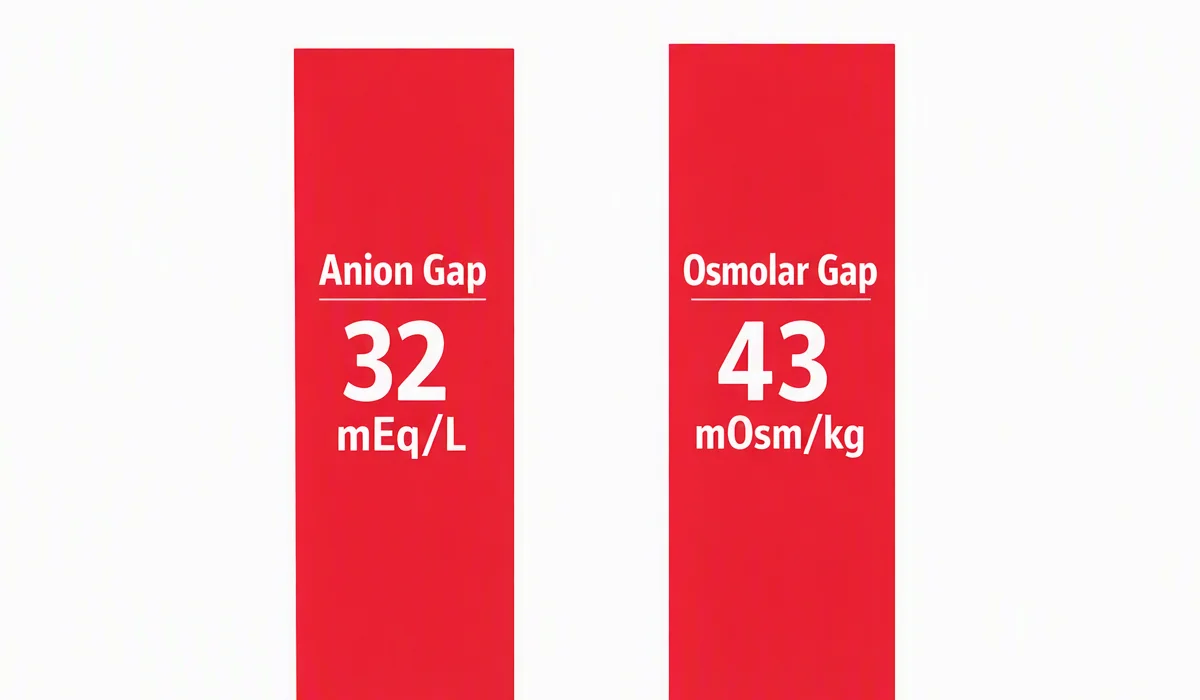
Methanol and ethylene glycol are small, osmotically active alcohols that produce two abnormalities simultaneously: they raise the osmolar gap (because they are unmeasured osmoles themselves) and, once metabolized by alcohol dehydrogenase into formic acid or glycolic acid, they raise the anion gap as well. The pairing of a high anion gap metabolic acidosis with a markedly elevated osmolar gap is the bedside signature of toxic alcohol poisoning and should trigger immediate measurement of levels and consideration of fomepizole or hemodialysis. For more on how the two gaps differ, see anion gap vs osmolar gap.
Limitations
The osmolar gap is a screening test, not a diagnostic one. A normal gap does not fully exclude toxic alcohol ingestion, because as the parent alcohol is metabolized into its acidic metabolites it stops contributing to the osmolar gap (which may fall toward normal) even as the anion gap rises. Conversely, a mildly elevated gap is non-specific and occurs in many critically ill patients without toxin exposure. The calculated osmolality formula itself is also approximate — variations exist that include potassium, or use slightly different divisors — so always read the gap together with the measured osmolality, the anion gap, and the clinical context.
This calculator runs entirely in your browser — no values are transmitted or stored. Reference logic is reviewed against StatPearls and LITFL. Results are informational only and should always be interpreted in full clinical context by a qualified clinician.
References
- Purssell RA, Pudek M, Ruer W, Findlay T, Chan J, Zed PJ. "Derivation and validation of a formula to calculate the contribution of ethanol to the osmolar gap." Ann Emerg Med. 2001;38(6):653–659. PubMed ↗
- Kraut JA, Xing SX. "Approach to the evaluation of a patient with an increased serum osmolal gap and high-anion-gap metabolic acidosis." Am J Kidney Dis. 2012;60(3):492–497. PubMed ↗
- Life in the Fast Lane (LITFL). "Osmolar Gap." litfl.com/osmolar-gap ↗
- Whitfield RA, Huddle KR, Smith P, Dohrmann J. "Methanol and ethylene glycol poisoning." In: StatPearls [Internet]. Treasureville (FL): StatPearls Publishing. NCBI Bookshelf ↗