Anion Gap Formula Explained
The anion gap formula AG = Na⁺ − (Cl⁻ + HCO₃⁻) is derived from the principle of electroneutrality. Here is the full derivation, the potassium-inclusive variant, albumin correction, and worked examples with real numbers.
The anion gap equation
The anion gap formula — AG = Na⁺ − (Cl⁻ + HCO₃⁻) — is one line of arithmetic, but it rests on a deep physiological law: the principle of electroneutrality1. In any body-fluid compartment, total positive charge must equal total negative charge. Serum cations are dominated by sodium (Na⁺) plus small contributions from potassium (K⁺), calcium, and magnesium; serum anions are dominated by chloride (Cl⁻) and bicarbonate (HCO₃⁻) plus "unmeasured" anions such as albumin, phosphate, sulfate, and organic anions (lactate, ketones)1.
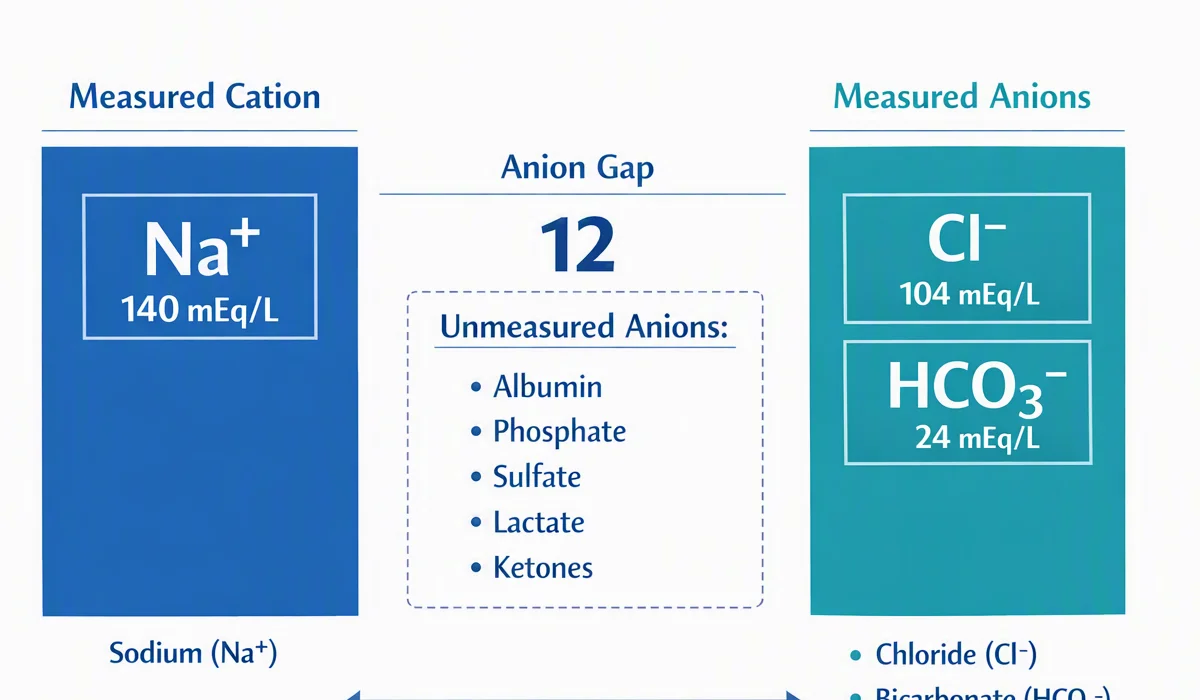
Writing electroneutrality out and grouping the measured from the unmeasured ions gives the anion gap equation. The cation side minus the anion side must balance, so:
By convention we drop the minor cations (K⁺, Ca²⁺, Mg²⁺) from the daily clinical formula because they are small and relatively constant. What remains is the gap between the major measured cation (sodium) and the two major measured anions (chloride and bicarbonate). That gap is not empty space — it is filled by the unmeasured anions. When those unmeasured anions accumulate (lactate in shock, ketoacids in DKA, uremic toxins in renal failure, organic acids from toxic alcohols), the calculated anion gap rises. This is why the formula is such an effective screen for metabolic acidosis.
Step-by-step calculation
To calculate the anion gap by hand, follow three steps:
- Add the measured anions: Cl⁻ + HCO₃⁻.
- Subtract from sodium: Na⁺ − (Cl⁻ + HCO₃⁻).
- Compare to the reference interval (conventionally 8–12 mEq/L).
Example A — normal result. A routine panel returns Na⁺ 140, Cl⁻ 104, HCO₃⁻ 24 mEq/L. Sum the anions: 104 + 24 = 128. Subtract from sodium: 140 − 128 = 12 mEq/L, sitting at the top of the normal range.
Example B — elevated result. A septic patient's panel returns Na⁺ 138, Cl⁻ 101, HCO₃⁻ 18 mEq/L. Sum the anions: 101 + 18 = 119. Subtract from sodium: 138 − 119 = 19 mEq/L, a mildly elevated gap consistent with a high-anion-gap metabolic acidosis such as lactic acidosis. You can confirm both results in the anion gap calculator, which also applies the albumin correction automatically.
The potassium-inclusive variant
Some laboratories and textbooks add potassium to the cation side, giving AG = (Na⁺ + K⁺) − (Cl⁻ + HCO₃⁻). Because serum K⁺ is small relative to Na⁺ and tightly regulated, including it shifts the normal range upward to roughly 10–20 mEq/L. Most modern practice omits potassium for simplicity, reserving the K⁺-inclusive equation for specific settings (hyperkalemic acidosis, renal physiology teaching). The full derivation and clinical indications are covered on the dedicated formula with potassium page.
Reference ranges and why labs differ
The conventional reference interval quoted for the anion gap is 8–12 mEq/L, the value most clinicians carry in their heads1. Modern autoanalyzers using ion-selective electrodes, however, often report a tighter 3–11 mEq/L range2. The discrepancy comes down to how chloride is measured: newer assays report slightly higher Cl⁻ values, which shrinks the calculated gap. Each laboratory prints its own reference interval, and the clinically correct move is to interpret your result against that lab's range rather than a universal number. The normal anion gap range page breaks this down lab by lab and by age group.
Albumin correction
Albumin contributes roughly 75% of the "normal" anion gap, so when it falls, the expected gap falls with it3. Each 1 g/dL decrease in albumin lowers the normal anion gap by about 2.5 mEq/L3. The albumin-corrected formula restores comparability: corrected AG = observed AG + 2.5 × (4.0 − albumin g/dL)3. Without it, a hypoalbuminemic ICU patient can have a frankly elevated acidosis hidden behind a deceptively "normal" raw gap.
For worked case examples showing each variant of the formula in action — from straightforward HAGMA to mixed disorders resolved with the delta ratio — see the HAGMA guide and the clinical case studies.
References
- Kraut JA, Madias NE. "Serum Anion Gap: Its Uses and Limitations in Clinical Medicine." Clin J Am Soc Nephrol. 2007;2(1):162–174. PubMed ↗
- Pandey DG, Sharif A. "Biochemistry, Anion Gap." StatPearls [Internet]. Treasureville (FL): StatPearls Publishing; 2023. NCBI Bookshelf ↗
- Figge J, Jabor A, Kazda A, Fencl V. "Anion gap and hypoalbuminemia." Crit Care Med. 1998;26(11):1807–1810. PubMed ↗
- Life in the Fast Lane (LITFL). "Anion Gap." litfl.com/anion-gap ↗