Toxin-Induced High Anion Gap
Several toxins produce a high anion gap metabolic acidosis, often rapidly and with little clinical warning. The classic teaching is to measure the gap and the osmolar gap together — the pair is nearly diagnostic of toxic alcohol ingestion.
Why toxins widen the anion gap
Toxin-induced high anion gap metabolic acidosis is one of the most time-critical diagnoses in medicine. The offending agents share a common mechanism: the parent compound or one of its metabolites is an organic acid whose anion accumulates as an "unmeasured anion" and widens the high anion gap exactly as lactate, ketones, and uremic acids do. The clinical challenge is identifying the toxin quickly, because specific antidotes (fomepizole, hemodialysis) are time-sensitive and the parent alcohol is often not detected by routine laboratory assays. The elevated gap is therefore a starting point, not a diagnosis.
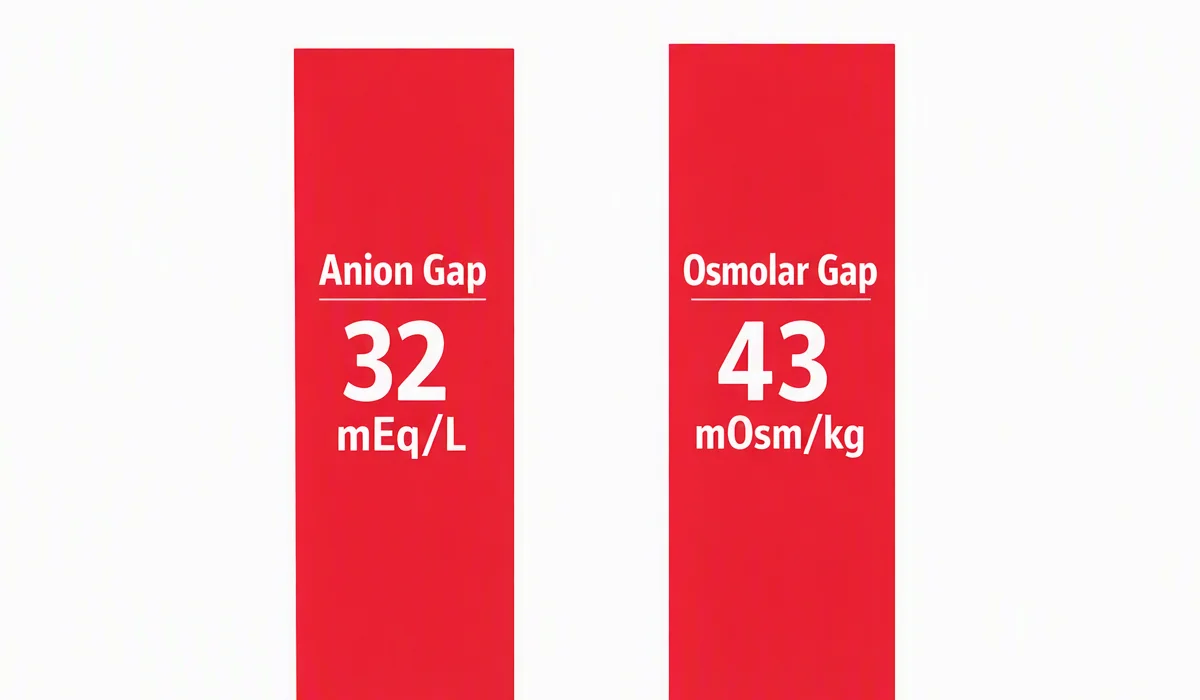
The crucial bedside pairing is the anion gap + osmolar gap. The osmolar gap is the difference between the measured serum osmolarity and the calculated osmolarity (2 × Na⁺ + glucose + BUN, all in mg/dL ÷ 18, or the simpler 2 × Na⁺ + glucose/18 + BUN/2.8). A high osmolar gap indicates the presence of a small, osmotically active solute — typically a parent alcohol — that the standard formula does not account for. Measured together, the two gaps narrow the differential dramatically.
Methanol and ethylene glycol — the high-AG / high-osmolar-gap pair
Methanol (found in windshield washer fluid, antifreeze, solvents, "moonshine") and ethylene glycol (automotive antifreeze) are the two toxic alcohols most likely to present with simultaneous high anion gap and high osmolar gap. Neither parent alcohol is itself an acid; the toxicity comes from their hepatic metabolism by alcohol dehydrogenase to highly acidic metabolites:
- Methanol → formaldehyde → formic acid. Formate is the offending anion; it causes severe metabolic acidosis and characteristic retinal/optic nerve toxicity ("snowstorm vision," blindness).
- Ethylene glycol → glycoaldehyde → glycolic acid → glyoxylic acid → oxalic acid. Glycolate drives the acidosis; oxalate precipitates as calcium oxalate crystals in the renal tubules, producing AKI and crystalluria.
Early after ingestion — before significant metabolism — the picture is dominated by the osmolar gap with a normal or minimally elevated anion gap. As metabolism proceeds over hours, the osmolar gap falls (parent alcohol is consumed) while the widened gap rises (acidic metabolites accumulate). A patient who presents late may have a near-normal osmolar gap and a markedly elevated value. The full differential and clinical features are covered on the toxic alcohol poisoning page.
Fomepizole (4-methylpyrazole) competitively inhibits alcohol dehydrogenase and halts conversion of methanol or ethylene glycol to their toxic metabolites. It should be given immediately when a toxic alcohol is suspected — do not wait for confirmatory levels. The standard loading dose is 15 mg/kg IV1. Hemodialysis is indicated for severe metabolic acidosis, end-organ toxicity (visual changes, renal failure), or markedly elevated levels; it clears both the parent alcohol and the metabolites and corrects the acidosis2. Both interventions are most effective when started early.
Salicylate toxicity — mixed respiratory alkalosis and HAGMA
Salicylate (aspirin) poisoning produces a characteristic mixed acid-base pattern. Salicylates directly stimulate the medullary respiratory center, causing hyperventilation and a respiratory alkalosis within hours of ingestion. Later — particularly in chronic toxicity or with large acute overdoses — salicylates uncouple oxidative phosphorylation, impair Krebs cycle enzymes, and produce a concurrent high anion gap metabolic acidosis (from lactate and ketone accumulation). The result is the classic finding of a primary respiratory alkalosis with a primary high-anion-gap metabolic acidosis — one of the few disorders that produces a normal or alkalemic pH with a markedly elevated anion gap34.
The gap is therefore an essential clue in any confused, hyperventilating patient with a possible aspirin history, particularly the elderly with chronic ingestion. A serum salicylate level confirms the diagnosis. The clinical features, level correlation, and indications for urinary alkalinization and hemodialysis are detailed on the salicylate toxicity page.
Metformin-associated lactic acidosis (MALA)
Metformin is the most common prescription drug cause of Type B (non-hypoxic) lactic acidosis. The mechanism is inhibition of mitochondrial complex I, impairing hepatic gluconeogenesis from lactate and reducing peripheral lactate clearance. Metformin-associated lactic acidosis (MALA) is rare in patients with normal renal function, but the risk rises dramatically with accumulation — typically in CKD, acute kidney injury (contrast nephropathy is a classic trigger), hepatic failure, or overdose. The presentation is a severe high-gap metabolic acidosis with a markedly elevated lactate (often > 10 mmol/L), hypotension, and a high mortality.
Because metformin itself is small and dialyzable, hemodialysis clears both the drug and the lactate, and is indicated in severe MALA. Unlike toxic alcohols, there is no osmolar gap — the offending anion is lactate, not an unmeasured parent compound. This distinguishes MALA from methanol and ethylene glycol at the bedside.
Other toxin causes
Several other agents complete the toxin list:
- Iron. In massive overdose, free iron disrupts mitochondrial oxidative phosphorylation, producing a high anion gap metabolic acidosis (from lactate and a direct iron effect), often with prominent GI symptoms and shock.
- Isoniazid (INH). Inhibits pyridoxine (vitamin B₆)-dependent metabolism, depleting pyridoxal phosphate and producing a high anion gap metabolic acidosis (from lactate and ketoacids) accompanied by seizures that are refractory to standard anticonvulsants but respond to pyridoxine.
- Propylene glycol. A vehicle for several IV medications (lorazepam, diazepam, phenytoin, esmolol). High-dose or prolonged infusions in the ICU convert propylene glycol to lactate via alcohol dehydrogenase, generating a high anion gap metabolic acidosis often accompanied by an osmolar gap.
- 5-oxoproline (pyroglutamic acid). Chronic paracetamol (acetaminophen) use, especially in malnutrition or with flucloxacillin, can deplete glutathione and cause accumulation of 5-oxoproline — an unmeasured anion producing a high anion gap metabolic acidosis. GOLD MARK explicitly lists it for this reason.
- Cyanide and carbon monoxide. Produce lactic acidosis through cellular hypoxia; carbon monoxide itself does not contribute to the osmolar gap, but the resulting lactate widens the anion gap.
The simultaneous anion gap + osmolar gap workup
Whenever a toxin is suspected in a patient with an unexplained metabolic acidosis, send both simultaneously:
- Calculate the anion gap from the metabolic panel. An elevated gap identifies a HAGMA but does not specify the anion.
- Calculate the osmolar gap using the osmolar gap calculator. A high osmolar gap (> 10 mOsm/kg) indicates an unmeasured osmole — most commonly a parent alcohol (methanol, ethylene glycol, propylene glycol) or acetone (in DKA).
- Interpret the pair. High AG + high osmolar gap → toxic alcohols or propylene glycol. High AG + normal osmolar gap → salicylates, metformin, iron, INH, 5-oxoproline, lactate, ketones, uremia. High osmolar gap + normal AG → early toxic alcohol ingestion (before significant metabolism), or alcoholic ketoacidosis with acetone.
- Send confirmatory levels (salicylate, lactate, ketones, methanol, ethylene glycol, metformin) but do not delay empirical fomepizole, bicarbonate, or hemodialysis if the clinical picture fits.
The high-AG / high-osmolar-gap pair is one of the most powerful diagnostic combinations in emergency toxicology. A worked example of this workup, from the initial unexplained acidosis to confirmation and treatment, is in the ethylene glycol case study.
References
- "Fomepizole (Antizol) — Drug Information." Utah Poison Control / prescribing information, 15 mg/kg IV loading dose. Link ↗
- Roberts DM, Yates C, Megarbane B, et al. "Recommendations for the role of extracorporeal treatments in the management of acute methanol poisoning: a systematic review and consensus statement (EXTRIP)." Blood Purif. 2015;40(1-2):1-11. Link ↗
- "Salicylates Toxicity." StatPearls. NCBI Bookshelf. Link ↗
- "Salicylate Toxicity." Life in the Fast Lane (LITFL). Link ↗
- Kraut JA, Madias NE. "Serum anion gap: its uses and limitations in clinical medicine." Clin J Am Soc Nephrol. 2007;2(1):162-174. Link ↗
- Kharsa A, et al. "Anion Gap and Non-Anion Gap Metabolic Acidosis." StatPearls. NCBI Bookshelf. 2025. Link ↗