Causes of Normal Anion Gap Acidosis (NAGMA)
When metabolic acidosis develops but the anion gap stays in the reference range, the cause is bicarbonate loss or gain of chloride — a hyperchloremic (normal-AG) metabolic acidosis. The differential splits into GI, renal, and iatrogenic causes.
What is normal anion gap metabolic acidosis?
Normal anion gap metabolic acidosis (NAGMA) — also called hyperchloremic metabolic acidosis — is metabolic acidosis in which the anion gap remains in the 8–12 mEq/L range. The defining feature is that bicarbonate is lost (GI tract or kidney) or diluted, and chloride rises to preserve electroneutrality, so the measured gap stays normal even as serum bicarbonate falls. This is pathophysiologically distinct from high-anion-gap metabolic acidosis, where unmeasured anions accumulate. Confirm the gap with the urine anion gap calculator as part of the workup, and read the full clinical approach in our NAGMA guide.
Normal anion gap metabolic acidosis (NAGMA) is acidosis with a normal anion gap, caused by either bicarbonate loss (diarrhea, pancreatic/biliary fistulas, ureterosigmoidostomy) or failure of renal bicarbonate regeneration (renal tubular acidosis types I, II, and IV). It is also called hyperchloremic metabolic acidosis because chloride rises to replace the lost bicarbonate12.
Differential by category
The causes of normal anion gap acidosis sort into three practical buckets: gastrointestinal bicarbonate loss, renal tubular acidoses, and iatrogenic or dilutional causes.
| Category | Specific cause | Mechanism | Clue |
|---|---|---|---|
| GI bicarbonate loss | Diarrhea (most common GI cause) | Loss of HCO₃⁻-rich pancreatic and intestinal secretions; the kidney retains Cl⁻ to maintain electroneutrality | History; elevated urine anion gap (negative) |
| Ureterosigmoidostomy / ileal conduit surgery | Colon reabsorbs Cl⁻ in exchange for secreting HCO₃⁻; chloride enters the blood | Surgical history; hyperchloremia | |
| Villous adenoma, laxative abuse, cholestyramine | Secretion of bicarbonate-rich mucus or binding of bile salts | Hypokalemia; medication history | |
| Pancreatic, biliary, or small-bowel fistulas | Direct loss of alkaline digestive secretions | Post-surgical or trauma context | |
| Renal tubular acidosis (RTA) | Type I (distal) RTA | Impaired distal H⁺ secretion → inability to acidify urine (urine pH > 5.5); bicarbonate wasting | Hypokalemia; alkaline urine; nephrocalcinosis |
| Type II (proximal) RTA | Reduced proximal bicarbonate reabsorption threshold → bicarbonaturia until serum HCO₃⁻ falls to the new threshold | Hypokalemia; Fanconi syndrome features | |
| Type IV RTA | Hypoaldosteronism (diabetic nephropathy, ACE inhibitors, ARBs, K⁺-sparing diuretics) → reduced NH₃ generation and H⁺ secretion | Hyperkalemia (the distinguishing feature) | |
| Iatrogenic & dilutional | Normal saline administration (large-volume 0.9% NaCl) | Excess Cl⁻ load lowers the strong ion difference (SID); dilutional acidosis | Post-resuscitation; hyperchloremia |
| Acetazolamide (carbonic anhydrase inhibitor) | Blocks proximal HCO₃⁻ reabsorption → bicarbonaturia | Medication history; alkaline urine | |
| Total parenteral nutrition with excess arginine, lysine, or chloride salts | Cationic amino acids lower SID; Cl⁻ load | TPN dependence | |
| Ammonium chloride, toluene inhalation (glue sniffing) | Exogenous HCl or hippuric acid load with rapid renal hippurate excretion | Toxin history; hippurate in urine |
GI causes — diarrhea is the prototype
Diarrhea is the most common cause of NAGMA in clinical practice. Pancreatic and intestinal secretions are rich in bicarbonate (60–80 mEq/L), so each liter lost takes bicarbonate with it. The kidney compensates by retaining chloride, producing the hyperchloremia that defines this disorder. The urine anion gap (UAG = urine Na⁺ + urine K⁺ − urine Cl⁻) is the key bedside discriminator: a negative UAG indicates appropriate renal NH₄⁺ excretion and points to a GI source; a positive UAG indicates the kidney is the source (renal tubular acidosis).
Renal tubular acidosis — type I, II, and IV
RTA encompasses three distinct tubular defects. Type I (distal) RTA is a failure of alpha-intercalated cells to secrete H⁺, so the urine stays inappropriately alkaline (pH > 5.5) despite systemic acidosis — classically associated with nephrocalcinosis, nephrolithiasis, and autoimmune disease (Sjögren's). Type II (proximal) RTA reflects a lowered bicarbonate reabsorption threshold and often coexists with Fanconi syndrome (glycosuria, aminoaciduria, phosphaturia). Type IV RTA is the most common in adults — hypoaldosteronism or tubular resistance to aldosterone reduces NH₃ generation and H⁺ secretion, and the serum potassium is elevated, which is the single feature that distinguishes it from types I and II123.
Iatrogenic and dilutional causes
Large-volume normal saline resuscitation produces a predictable dilutional (or "SID-mediated") hyperchloremic acidosis: the strong ion difference falls because chloride rises disproportionately, the serum bicarbonate is diluted, and the anion gap stays normal. Acetazolamide (for glaucoma, altitude sickness, or diuresis) inhibits proximal tubular carbonic anhydrase and causes bicarbonaturia. These causes are common, reversible, and recognized by the medication and fluid history.
If the anion gap is in the normal range but the bicarbonate is low, you are dealing with NAGMA. Compute the urine anion gap next — a negative UAG means a GI source (diarrhea), and a positive UAG means a renal source (RTA). A serum potassium then separates Type IV RTA (high K⁺) from Types I and II (low K⁺).
Key takeaways
- NAGMA = metabolic acidosis with a normal anion gap, caused by bicarbonate loss or chloride gain.
- Three categories: GI loss (diarrhea, fistulas), renal (RTA I, II, IV), and iatrogenic (saline, acetazolamide, TPN).
- The urine anion gap separates GI (negative UAG) from renal (positive UAG) causes.
- Always rule out a coexisting low anion gap masking HAGMA — see causes of a low anion gap.
The HARDUP mnemonic for normal anion gap acidosis
Just as MUDPILES organizes the high-anion-gap differential, HARDUP is the bedside mnemonic for the causes of normal anion gap (hyperchloremic) metabolic acidosis34. Each letter names a process that lowers serum bicarbonate without generating unmeasured anions — so the gap stays put while chloride climbs to preserve electroneutrality. The mnemonic is most useful as a recall scaffold once NAGMA is identified on the chemistry panel; it is not a substitute for the urine anion gap and the clinical history, which together localize the cause to the gut, the kidney, or an iatrogenic source.
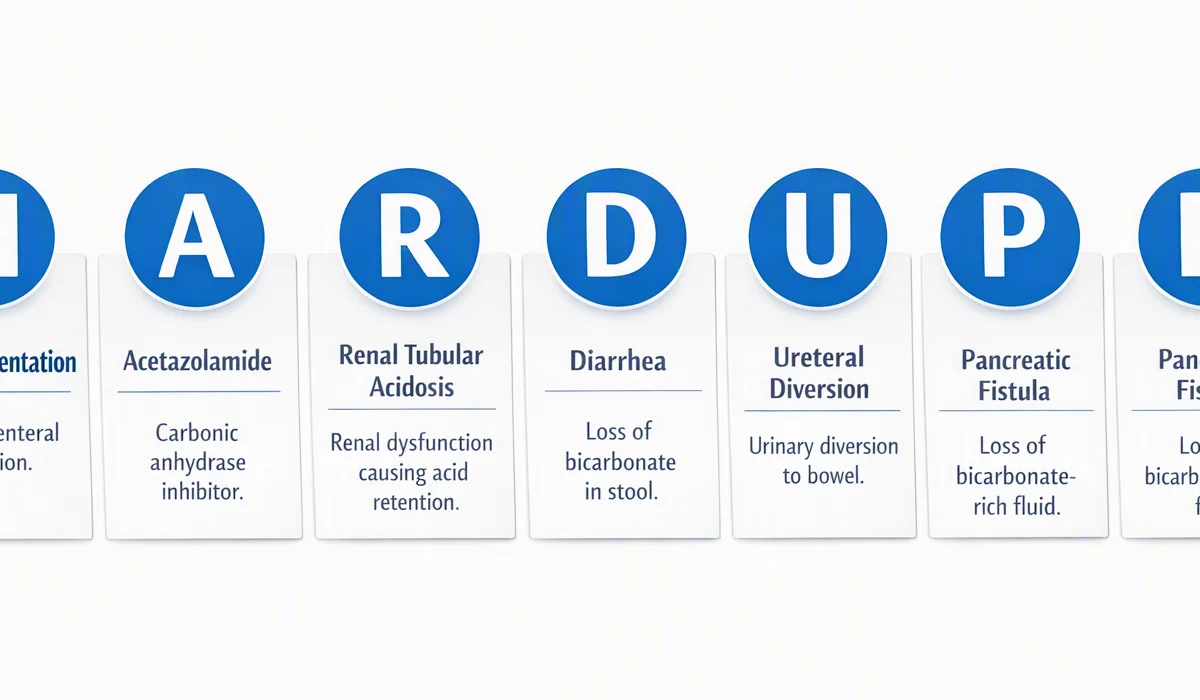
HARDUP is the normal-anion-gap counterpart to MUDPILES — together they cover the full metabolic acidosis differential. When the gap is elevated, walk MUDPILES (and its modern update MUDPILES → GOLD MARK); when the gap is normal, walk HARDUP. The full clinical approach to each entry is in our NAGMA guide.
References
- Kharsa A, Konanki V. "Anion Gap and Non-Anion Gap Metabolic Acidosis." StatPearls [NCBI Bookshelf]. 2025. Link ↗
- LITFL. "Normal Anion Gap Metabolic Acidosis (NAGMA) — CCC Acid-base." Life in the Fast Lane. Link ↗
- Kraut JA, Madias NE. "Serum anion gap: uses and limitations." Clinical Journal of the American Society of Nephrology (CJASN). 2007. Link ↗
- Renal Fellow Network. "Mnemonic for Non-Anion Gap Metabolic Acidosis (HARDUP)." Renal Fellow Network. 2008. Link ↗
- Karet FE. "Mechanisms in distal renal tubular acidosis." Journal of the American Society of Nephrology (JASN). Link ↗
Solve the normal-gap acidosis.
Calculate the anion gap, check the urine anion gap, and separate GI from renal NAGMA — all in one free hub.
Open the urine anion gap calculator