How do you calculate the anion gap?
The anion gap is calculated from three values on a basic metabolic panel using the formula AG = Na⁺ − (Cl⁻ + HCO₃⁻). Here is the four-step method, a worked example with numbers, and when to apply albumin correction.
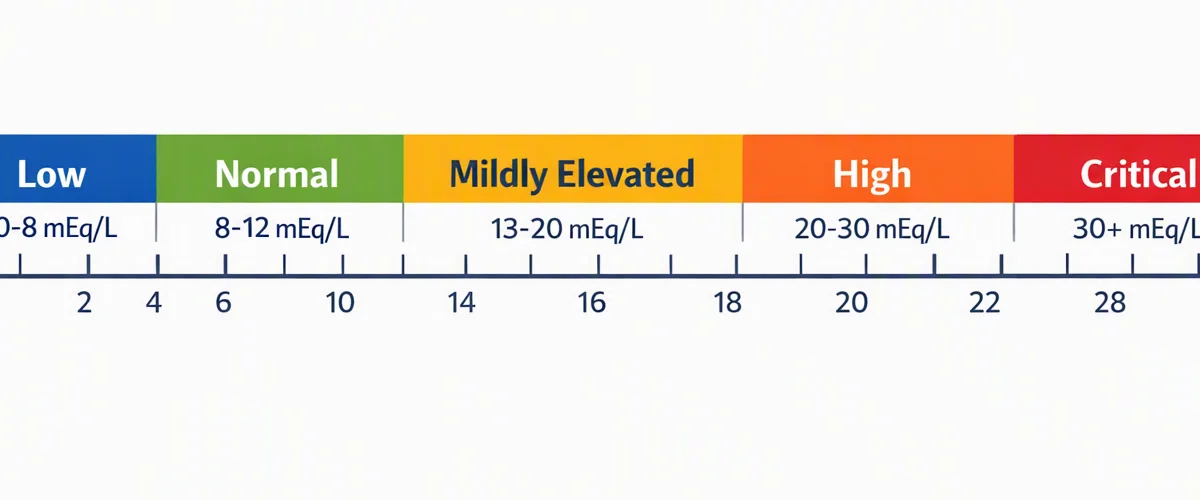
The anion gap calculation requires only three numbers from the routine basic metabolic panel (BMP): sodium (Na⁺), chloride (Cl⁻), and bicarbonate (HCO₃⁻). Apply the formula AG = Na⁺ − (Cl⁻ + HCO₃⁻)1, compare the result to the conventional reference range of 8–12 mEq/L12, then correct for albumin if needed. You can run any values through our anion gap calculator to do this instantly.
The four steps
- Get the electrolytes. Pull Na⁺, Cl⁻, and HCO₃⁻ from the BMP. All three are reported in mEq/L (equivalent to mmol/L for these monovalent ions)3, so no unit conversion is needed.
- Add the anions. Sum chloride and bicarbonate:
Cl⁻ + HCO₃⁻. - Subtract from sodium.
AG = Na⁺ − (Cl⁻ + HCO₃⁻). This is the anion gap in mEq/L. - Compare to the reference range and correct for albumin. A normal gap is 8–12 mEq/L1. If albumin is abnormal, apply the albumin-corrected anion gap (Figge equation)4 — see the corrected AG calculator or the why albumin matters page.
For the full formula derivation — why the equation works, the electroneutrality principle behind it, and the potassium-inclusive variant (Na⁺ + K⁺) − (Cl⁻ + HCO₃⁻) — see our anion gap formula page.
Worked example
A 54-year-old with sepsis has the following BMP:
Step 1 — add the anions: 104 + 20 = 124.
Step 2 — subtract from sodium: 140 − 124 = 16 mEq/L. The uncorrected anion gap is 16 — already elevated above 12.
Step 3 — albumin correction. Because albumin is low at 2.4 g/dL, the uncorrected gap understates the true elevation. Apply the Figge equation4: 16 + 2.5 × (4.0 − 2.4) = 16 + 4.0 = 20 mEq/L. The albumin-corrected anion gap is 20 — overt high anion gap metabolic acidosis. In this septic patient that points squarely at lactic acidosis, and the next step is a serum lactate.
Without correction, this patient's gap of 16 looks only mildly elevated. After correction it is 20 — a 4 mEq/L difference that changes the interpretation from "borderline" to "overt HAGMA." Always correct when albumin is outside 3.5–5.0 g/dL.
Quick reference: the formula and range
| Item | Value |
|---|---|
| Formula | Na⁺ − (Cl⁻ + HCO₃⁻) |
| Units | mEq/L (= mmol/L for monovalent ions) |
| Normal range | 8–12 mEq/L (modern labs: 3–11) |
| Albumin correction | AG + 2.5 × (4.0 − albumin g/dL) |
| K⁺-inclusive formula | (Na⁺ + K⁺) − (Cl⁻ + HCO₃⁻), normal 10–20 |
Once you have the gap, the next analytic step — when the gap is elevated and the bicarbonate is low — is the delta ratio (ΔAG / ΔHCO₃⁻), which separates a pure HAGMA from a mixed acid–base disorder.
References
- Pandey DG, Brentnjens M. "Biochemistry, Anion Gap." StatPearls [Internet]. Treasure Point (FL): StatPearls Publishing. (Formula AG = Na − (Cl + HCO₃); normal 8–12 mEq/L.) Link ↗
- Kraut JA, Madias NE. "Serum Anion Gap: Its Uses and Limitations in Clinical Medicine." Clin J Am Soc Nephrol. 2007;2(1):162-174. Link ↗
- Life in the Fast Lane (LITFL). "Anion Gap." CCC Acid-Base. (mEq/L = mmol/L for monovalent ions.) Link ↗
- Figge J, et al. "The role of serum proteins in acid-base equilibria." J Lab Clin Med. 1998;117(6):453-467. (Figge equation: AG + 2.5 × (4.0 − albumin g/dL).) See also MDCalc — Anion Gap. Link ↗
Skip the arithmetic.
Enter Na⁺, Cl⁻, and HCO₃⁻ and get the anion gap, albumin-corrected value, and interpretation instantly.
Open the anion gap calculator