Anion Gap 14, 15, 19, 20 — What Your Value Means
The anion gap is calculated as Na⁺ − (Cl⁻ + HCO₃⁻) and normally sits at 8–12 mEq/L. A specific number — 14, 15, 19, or 20 — has meaning only against the lab's reference range, the albumin level, and the patient's context. Here is a value-by-value guide.
Reading your anion gap result
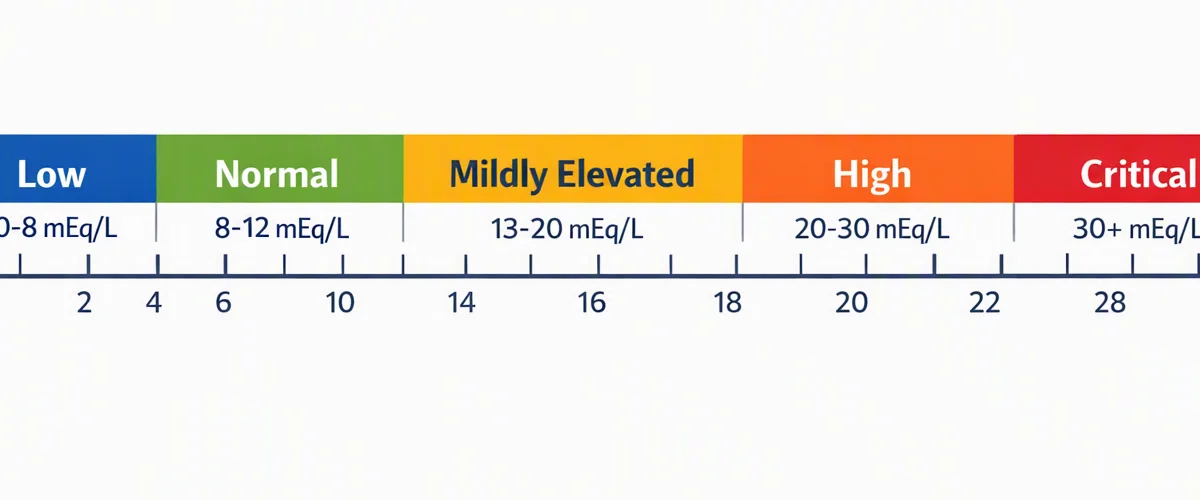
The anion gap is one number, but no single value is meaningful on its own. The conventional normal anion gap range is 8–12 mEq/L, although modern ion-selective analyzers may use a tighter 3–11 mEq/L interval because they measure chloride more accurately. Always interpret your result against the reference range printed on your own lab report — a gap of 14 is mildly elevated in one lab and normal in another.
Two caveats change the reading before anything else. First, albumin correction: each 1 g/dL drop in albumin lowers the expected gap by ~2.5 mEq/L, so a hypoalbuminemic patient with a "normal" gap of 10 may in fact have a masked HAGMA1. Second, lab variation: small differences in Na⁺, Cl⁻, or HCO₃⁻ measurement move the gap by several points. A borderline value should always be repeated.
What does an anion gap of 14, 15, 19, or 20 mean?
The table below maps specific anion gap values to severity, the likely interpretation, typical causes, and a practical action. Use it as a starting point — clinical context and albumin correction always override the raw number.
| Anion gap (mEq/L) | Severity | Likely interpretation | Typical causes | Action |
|---|---|---|---|---|
| 3 | Low | Below reference interval | Hypoalbuminemia, paraproteinemia (myeloma), lab error | Repeat the panel; check albumin |
| 8 | Normal (low end) | Within range | — (or masked acidosis if albumin low) | Correct for albumin if ill |
| 10 | Normal (mid) | Within range | Healthy baseline | No action |
| 12 | Upper normal | Borderline | Early elevation possible; depends on albumin | Recheck; correlate with bicarbonate |
| 14 | Mildly elevated | Early HAGMA — small acid load | Mild lactic acidosis, early ketoacidosis, early uremia | Clinical correlation; recheck + lactate |
| 16 | Elevated | Established HAGMA | Lactate, ketones, renal failure, toxins | Initiate workup — lactate, ketones, BUN/Cr |
| 18 | Significantly elevated | Clear HAGMA | DKA, sepsis/lactic acidosis, uremia | Full workup; check osmolar gap |
| 20 | Markedly elevated | Significant HAGMA requiring workup | Overt DKA, severe lactic acidosis, toxic alcohol | Urgent evaluation; consider toxin screen |
| 25 | Severely elevated | Severe HAGMA | Toxic alcohols, profound DKA, severe shock | Emergency workup; osmolar gap; toxin levels |
| 30+ | Critical | Strongly suggests toxic alcohol ingestion | Methanol, ethylene glycol; profound DKA | Emergency — empiric fomepizole pending levels |
So: an anion gap of 14 is mildly elevated; 15 to 19 indicates a developing high-anion-gap metabolic acidosis; and 20 or above is a significant elevation requiring clinical workup12. The exact significance depends on the lab's reference range, the patient's albumin level, and concurrent clinical conditions.
Why the same number means different things
Two patients with the same anion gap of 16 can have very different problems. The albumin level is the single biggest confounder — a gap that looks normal in a hypoalbuminemic, cirrhotic, or nephrotic patient may be hiding a true HAGMA. Always compute the albumin-corrected value with the corrected anion gap calculator before drawing conclusions. A 16 in a patient with albumin of 2.0 g/dL, corrected, is closer to 21 — clearly elevated.
Then there is lab variation. The same blood sent to two analyzers can yield anion gaps differing by 2–3 mEq/L because chloride assays are not perfectly standardized across platforms. This is why small, isolated elevations (13–15) deserve a repeat draw before a workup is launched, and why the normal anion gap range matters more than the absolute number.
An anion gap above 20 mEq/L, or any elevation with symptoms (rapid breathing, confusion, hypotension), warrants prompt evaluation. The full high anion gap workup — lactate, ketones, renal function, and the osmolar gap — is the right next step. A borderline gap of 14–15 in an asymptomatic patient usually merits a repeat panel and albumin correction first.
Key takeaways
- 8–12 mEq/L is the conventional normal range — but always read the lab's own interval.
- 14 = mildly elevated; 15–19 = developing HAGMA; ≥20 = significant, requiring workup.
- Albumin correction is mandatory — hypoalbuminemia is the most common reason a true elevation is missed.
- Always repeat borderline values before launching an extensive workup.
References
- Kraut JA, Madias NE. "Serum anion gap: its uses and limitations in clinical medicine." Clin J Am Soc Nephrol. 2007;2(1):162-174. Link ↗
- Kharsa A, et al. "Anion Gap and Non-Anion Gap Metabolic Acidosis." StatPearls. NCBI Bookshelf. 2025. Link ↗
- "Anion Gap." Life in the Fast Lane (LITFL). Link ↗
- Pandey DG, et al. "Biochemistry, Anion Gap." StatPearls. NCBI Bookshelf. 2023. Link ↗
Plug in your values. Get the answer.
Calculate the anion gap from Na⁺, Cl⁻, and HCO₃⁻ — then correct for albumin to know if it is truly elevated.
Open the anion gap calculator