DKA Management & the Anion Gap
In diabetic ketoacidosis the anion gap is the single most important biochemical endpoint. Glucose falls long before ketoacids clear, so following glucose alone will mislead you. The true measure of resolution is anion gap closure — and it dictates when fluids change and when insulin can be tapered.
Why the gap — not glucose — marks DKA resolution
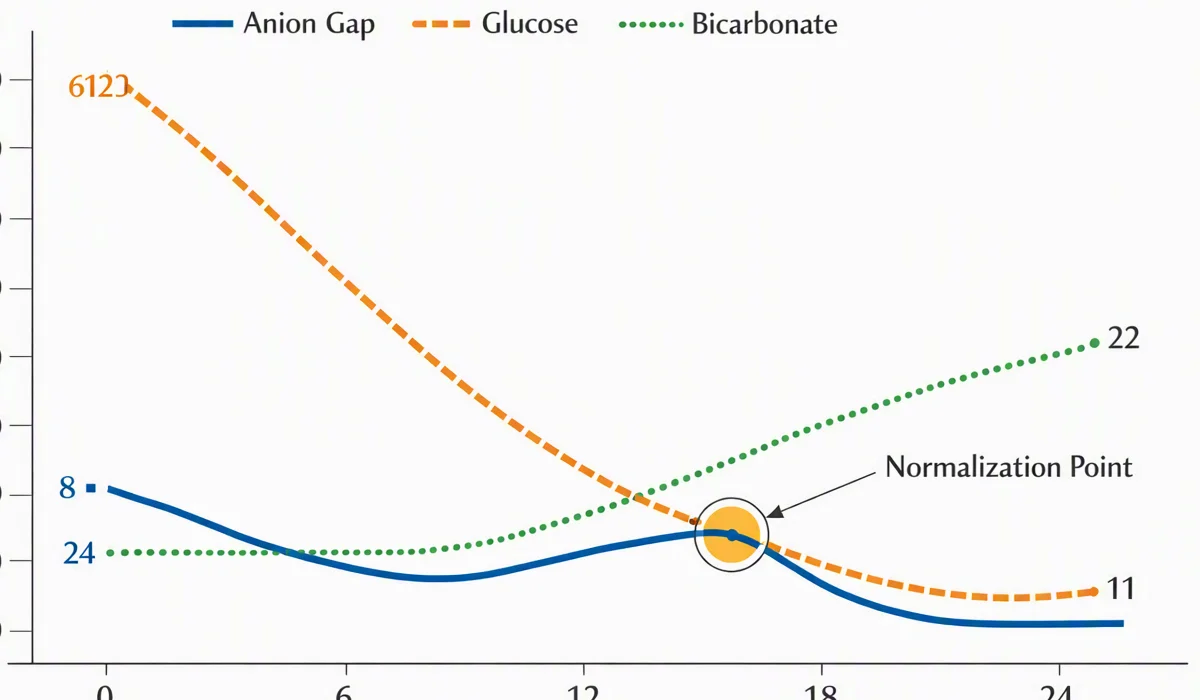
Diabetic ketoacidosis is, biochemically, a high anion gap metabolic acidosis driven by β-hydroxybutyrate and acetoacetate. Insulin stops ketogenesis and intravenous fluids restore perfusion and glucose clearance, so both the glucose and the gap fall during treatment. But they fall at different rates: glucose typically normalises within 6–12 hours, while the ketoacid pool — and therefore the elevated anion gap — may persist for many more hours, especially if insulin is under-dosed or interrupted.
This is why every DKA guideline now tracks the anion gap calculator result (calculated every 2–4 hours) rather than glucose as the marker of metabolic recovery. A patient whose glucose has fallen to 150 mg/dL but whose anion gap is still 22 mEq/L is not yet out of DKA — they are simply a euglycemic DKA in progress, and stopping insulin prematurely will allow ketogenesis to resume. See the broader pathophysiology discussion in DKA and the anion gap.
Anion gap closure triggers the fluid switch
The defining protocol transition in DKA management is keyed to the anion gap, not to glucose. The standard sequence:
- Initial resuscitation with isotonic saline (or a balanced crystalloid) to restore intravascular volume and improve tissue perfusion.
- Insulin infusion at a fixed rate (typically 0.1 units/kg/h) to suppress ketogenesis — the primary disease-modifying intervention.
- Switch to dextrose-containing fluid — usually 5% dextrose with half-normal saline — the moment the anion gap closes (drops below ~12 mEq/L, or below the upper limit of the lab's reference range) or the serum glucose falls below ~200 mg/dL, whichever comes first.
- Continue insulin at a reduced rate, layered with dextrose, until the gap is closed and ketones clear, then transition to subcutaneous insulin.
The logic of the dextrose switch is that insulin clearance of ketones must continue even after glucose has normalised. Giving dextrose lets you keep the insulin drip running at a ketogenesis-suppressing dose without producing hypoglycaemia. Premature discontinuation of insulin at "normal glucose" — while the gap is still elevated — is a classic cause of DKA rebound.
The hyperchloremic acidosis of saline resuscitation
After several litres of normal saline, the typical DKA patient develops a hyperchloremic (normal anion gap) metabolic acidosis that replaces the original high anion gap acidosis. The bicarbonate stays low, the pH stays acidemic, but the anion gap has closed. This is expected and is not failure of treatment — distinguish it with the delta ratio.
The mechanism is straightforward. Large-volume saline delivers a supraphysiologic chloride load that widens the strong ion difference toward chloride; the kidney excretes bicarbonate to maintain electroneutrality, and a hyperchloremic metabolic acidosis results. The ketoacid anions (β-hydroxybutyrate, acetoacetate) are metabolised to bicarbonate by insulin, but this regenerated bicarbonate is then "spent" buffering the new chloride-driven acidosis — so the serum bicarbonate stays depressed even as the gap closes.
This is the classic situation where the delta gap calculator or delta ratio is essential. In pure resolving DKA the rise in anion gap matches the fall in bicarbonate (delta ratio ≈ 1). Once hyperchloremic acidosis supervenes, the ratio falls toward 0.5–0.8, signalling a mixed high- and normal-anion-gap metabolic acidosis. Recognising this pattern prevents the error of escalating insulin or fluids for a "non-resolving" acidosis that is in fact a benign iatrogenic hyperchloremia.
Why bicarbonate is rarely given in DKA
Despite severe acidaemia, exogenous bicarbonate is not routine in DKA. Randomised evidence across multiple trials has failed to show a mortality or recovery benefit, and bicarbonate carries real harms: volume overload, hypokalaemia (as potassium shifts intracellularly with the rising pH), hypernatraemia, paradoxical central nervous system acidosis (CO₂ crosses the blood-brain barrier faster than bicarbonate), and prolonged ketogenesis (alkalaemia slows ketone clearance)12.
Most contemporary guidelines reserve bicarbonate for the narrow window of arterial pH < 6.9 (some centres extend to pH < 7.0) with haemodynamic instability, where the immediate risk of severe acidosis — arrhythmia, catecholamine refractoriness — outweighs the downsides. Even then, the goal is partial pH correction toward 7.15–7.20, not normalisation. If you do choose to give bicarbonate, estimate the deficit with the bicarbonate deficit calculator and give only a fraction of it, reassessing the pH. The full reasoning is walked through in the worked case: DKA.
Monitoring summary
| Marker | Frequency | What it tells you |
|---|---|---|
| Anion gap | Every 2–4 hours | Primary endpoint of ketoacid clearance; gates the dextrose switch. |
| Serum glucose | Hourly | Tracks hypoglycaemia risk; trigger for dextrose if < 200 mg/dL. |
| Potassium | Every 2–4 hours | Falls rapidly as acidosis corrects; replace aggressively to avoid arrhythmia. |
| β-hydroxybutyrate (if available) | Every 4–6 hours | Direct measure of the offending ketone; tracks with the gap. |
| Venous / arterial pH | Every 4–6 hours | Confirms acidosis severity; may stay low with hyperchloremic component. |
The key clinical habit is to anchor on the anion gap. Glucose will get there first; the gap tells you when ketoacid production has actually stopped. Treat the gap, not the glucose.
References
- Kitabchi AE, et al. "Hyperglycemic crises in adult patients with diabetes." Diabetes Care. 2009 (ADA Consensus). Link ↗
- Chua HR, et al. "Bicarbonate in diabetic ketoacidosis — a systematic review." Annals of Emergency Medicine / Cochrane. Link ↗
- Dhatariya KK, et al. "Management of diabetic ketoacidosis (JBDS-IP guideline)." Joint British Diabetes Societies. Link ↗
- StatPearls. "Diabetic Ketoacidosis (DKA)." NCBI Bookshelf. Link ↗