What Cancers Show a Low Anion Gap?
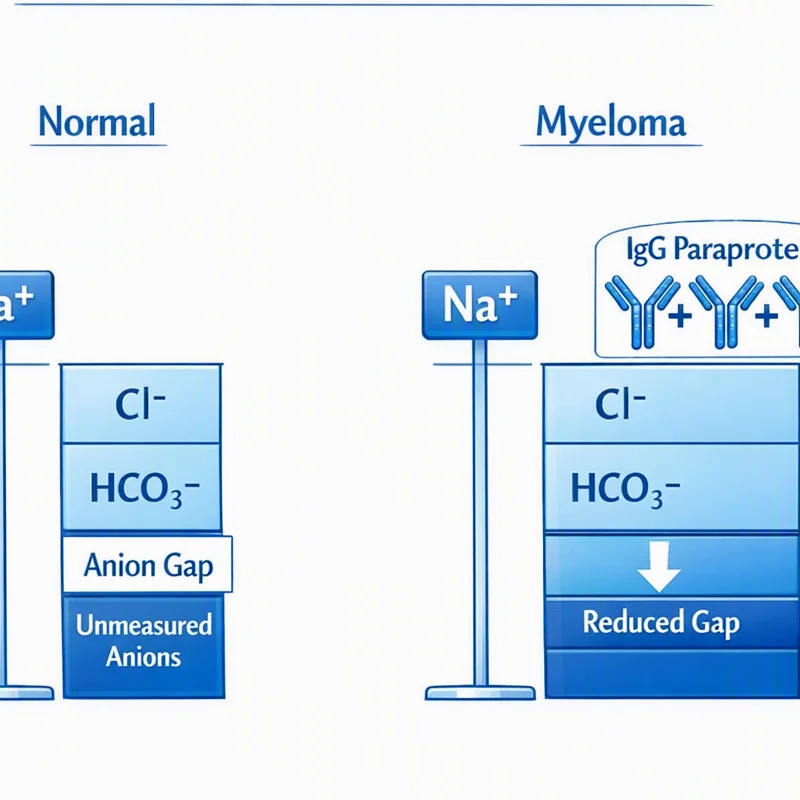
The cancer most commonly associated with a low anion gap is multiple myeloma. Its monoclonal proteins are positively charged (cationic IgG), which narrows — and sometimes negates — the gap. A persistently low anion gap can be an early clue to a plasma cell dyscrasia.
Patients who see a low anion gap often ask whether cancer is the cause. Usually it is not — hypoalbuminemia and lab error are far more common (see the causes of low anion gap). But among cancers, one diagnosis dominates: multiple myeloma.
The connection: multiple myeloma and the anion gap
The gap (Na⁺ − (Cl⁻ + HCO₃⁻)) exists because serum contains unmeasured ions — mostly negatively charged albumin and phosphate — that fill the space sodium does not cover. If unmeasured cations accumulate instead, the gap shrinks. That happens in myeloma: malignant plasma cells pour monoclonal immunoglobulin into the blood, and that paraprotein carries a net positive charge at physiologic pH, adding to the unmeasured cation pool and lowering the gap12.
How myeloma lowers the anion gap
IgG, the most common myeloma isotype, has an isoelectric point above 7.4, so at blood pH it behaves as a cationic protein. The effect is roughly linear: each 1 g/dL of paraprotein lowers the gap by about 2.5 mEq/L, so high-burden IgG myeloma can push the gap below 8 or into negative territory13. A low or negative gap with high total protein and low albumin (the wide "γ-gap") is a long-recognized early clue to a plasma cell dyscrasia — sometimes appearing before bone pain, anemia, or renal failure. IgA myeloma, by contrast, produces an anionic paraprotein that can paradoxically widen the gap3.
Myeloma workup triggered by a low anion gap
If the gap stays low after repeat testing and albumin correction, a structured myeloma workup follows — each step confirms a monoclonal protein or builds the case toward marrow biopsy:
| Step | Test | What it shows | Next step |
|---|---|---|---|
| 1 | Repeat BMP (Na⁺, Cl⁻, HCO₃⁻) | Confirms the low AG is real, not lab error | If still low → proceed |
| 2 | Serum + urine protein electrophoresis (SPEP / UPEP) | Detects a monoclonal (M) spike or Bence Jones protein | M-spike present → step 3 |
| 3 | Serum free light chains (κ / λ ratio) | Identifies light-chain-only disease; abnormal ratio is highly sensitive | Abnormal ratio → step 5 |
| 4 | Serum IgG / IgA / IgM quantification | Defines the isotype and burden of the paraprotein | Combined with SPEP for diagnosis |
| 5 | Calcium + creatinine + CBC + skeletal imaging | Screens for CRAB criteria (hyperCalcemia, Renal, Anemia, Bone) | CRAB present → step 6 |
| 6 | Bone marrow biopsy | ≥10% clonal plasma cells — definitive diagnosis | Hematology referral for staging |
Not just myeloma: other hematologic causes
A few related conditions also narrow the gap, though less prominently:
- MGUS (monoclonal gammopathy of undetermined significance) — a small, stable paraprotein; monitored, not treated.
- Waldenström macroglobulinemia — an IgM-secreting lymphoma; IgM is less cationic than IgG, so the effect is smaller.
- Heavy chain disease — rare monoclonal heavy-chain disorders behaving like a paraproteinemia.
In all three, an abnormal charged protein is added to the blood and shifts the low anion gap.
A single low anion gap is usually lab error or hypoalbuminemia — not cancer. Repeat the chemistry and check albumin first. Only a persistently low or negative gap — with high total protein, anemia, bone pain, or kidney dysfunction — justifies a myeloma workup, and many still end in MGUS or a benign cause.
Key takeaways
- The cancer most associated with a low anion gap is multiple myeloma (cationic IgG paraprotein).
- Each 1 g/dL of paraprotein lowers the gap by ~2.5 mEq/L; high-burden disease can drive a negative gap.
- A persistently low gap triggers SPEP/UPEP, free light chains, and CRAB screening toward marrow biopsy.
- A single low reading is usually lab error or hypoalbuminemia — repeat before worrying.
References
- Kraut JA, Madias NE. "Serum anion gap: uses and limitations." Clinical Journal of the American Society of Nephrology (CJASN). 2007. Link ↗
- Jurado RL. "Low anion gap and multiple myeloma." Southern Medical Journal. 1998. Link ↗
- Haber LA, Rastogi A, Steensma DP. "Why is the anion gap low?" Cleveland Clinic Journal of Medicine. 2023. Link ↗
- Figge J, et al. "Anion gap and hypoalbuminemia." Critical Care Medicine. 1998. Link ↗
- LITFL. "Low Anion Gap." Life in the Fast Lane. Link ↗
Low gap? Confirm it before chasing causes.
Repeat the chemistry, correct for albumin, then run the structured low-gap differential — all in one free hub.
Open the anion gap calculator