What is the difference between HAGMA and NAGMA?
HAGMA and NAGMA are the two forms of metabolic acidosis, separated by a single number — the anion gap. One is driven by added acids, the other by lost bicarbonate or gained chloride. The distinction changes the entire differential.
One acidosis, two mechanisms
Metabolic acidosis occurs when serum bicarbonate falls. Once you confirm acidemia (low pH / low HCO₃⁻), the next question is always the same: is the anion gap elevated or normal? That single branch splits metabolic acidosis into two wholly different diseases with different causes, workups, and management.
HAGMA (high anion gap metabolic acidosis) is acidosis with an elevated anion gap. The bicarbonate has been consumed by an acid the routine panel does not directly measure, and that acid's conjugate base shows up as an "unmeasured anion," widening the gap. The culprits are added acids: lactate, ketones, uremic solutes, and toxin metabolites. The full HAGMA differential is captured by MUDPILES / GOLD MARK.
NAGMA (normal anion gap metabolic acidosis), also called hyperchloremic metabolic acidosis, is acidosis with a normal anion gap metabolic acidosis pattern. Here bicarbonate is lost from the body (GI or kidney) or diluted by chloride-rich fluid, and the kidney/GI tract replaces the lost HCO₃⁻ with Cl⁻ to preserve electroneutrality. The gap stays normal because no new unmeasured anion is generated. The classic NAGMA causes are diarrhea, renal tubular acidosis, and saline dilution.
HAGMA vs NAGMA comparison
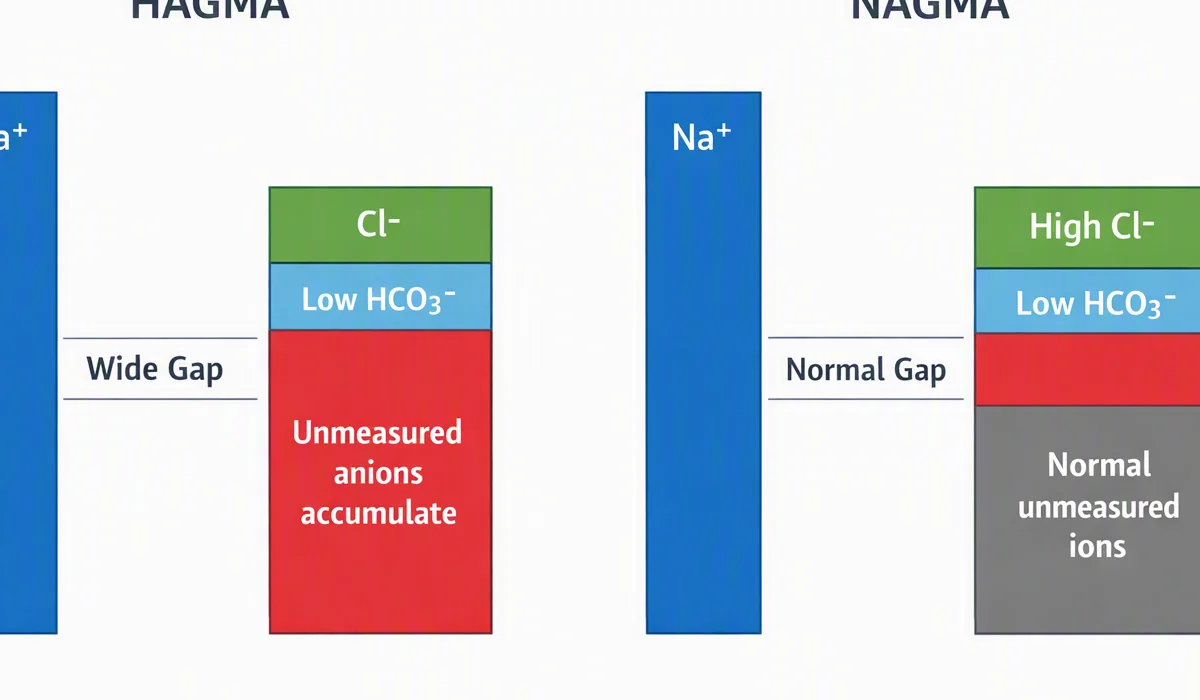
| Feature | HAGMA | NAGMA |
|---|---|---|
| Anion gap | Elevated (>12 mEq/L) | Normal (8–12 mEq/L) |
| Mechanism | Unmeasured acid added | HCO₃⁻ lost or Cl⁻ gained |
| Chloride | Variable, often normal | Elevated (hyperchloremic) |
| Classic causes | Lactate, ketones, uremia, toxins | Diarrhea, RTA, saline |
| Mnemonic | MUDPILES / GOLD MARK | HARDUPS / USED CRAP |
| Urine anion gap | Negative (high NH₄⁺ excretion) | Positive in renal causes; negative in GI causes |
HAGMA — added acids
In HAGMA the body is overwhelmed by an acid it cannot excrete or metabolize fast enough. Lactic acidosis (sepsis, shock), ketoacidosis (DKA, alcoholic, starvation), uremic acidosis (renal failure), and toxin-driven acidosis (methanol, ethylene glycol, salicylates, metformin) all generate anions that displace bicarbonate and widen the gap. Because the unmeasured anion is the clue, always correct for albumin before concluding the gap is normal — hypoalbuminemia can mask a true HAGMA. The cause list is taught with MUDPILES: Methanol, Uremia, DKA, Propylene glycol, Iron/INH, Lactic acidosis, Ethylene glycol, Salicylates.
NAGMA — lost bicarbonate or gained chloride
NAGMA has a narrower, more tractable differential. The gut loses bicarbonate in diarrhea, ileus, or ureterosigmoidostomy; the kidney wastes bicarbonate in renal tubular acidosis (RTA) types 1, 2, and 4 or in carbonic anhydrase inhibitors; and rapid saline resuscitation can dilute bicarbonate and raise chloride iatrogenically. The hallmark is a rising chloride that tracks the falling bicarbonate, leaving the gap unchanged.
Once NAGMA is confirmed, calculate the urine anion gap (urine Na⁺ + K⁺ − Cl⁻) as a surrogate for ammonium excretion. A negative urine anion gap means the kidney is excreting NH₄⁺ appropriately — the cause is extrarenal (typically diarrhea). A positive urine anion gap means the kidney is failing to excrete acid — the cause is renal (RTA). This single test localizes a NAGMA in seconds.
Can both occur at once?
Yes — and this is common in sick patients. A septic patient with diarrhea, or a DKA patient resuscitated with saline, can have a HAGMA and a NAGMA simultaneously. The delta ratio (ΔAG / ΔHCO₃⁻) detects this: a ratio near 1 is pure HAGMA, below 0.8 suggests a concurrent NAGMA, and above 2 suggests a coexisting metabolic alkalosis. Mixed disorders change management, so always calculate the delta ratio when the picture is unclear.
Key takeaways
- HAGMA = elevated anion gap from added unmeasured acids (lactate, ketones, uremia, toxins).
- NAGMA = normal anion gap from HCO₃⁻ loss or Cl⁻ gain (diarrhea, RTA, saline).
- The urine anion gap separates renal from GI causes of NAGMA.
- The delta ratio detects mixed HAGMA + NAGMA in the same patient.
Calculate the gap. Pick the differential.
Run the anion gap, then use the urine anion gap and delta ratio to localize the cause.
Open the anion gap calculator